Alternatives to the Cliché "I'm Not Racist"
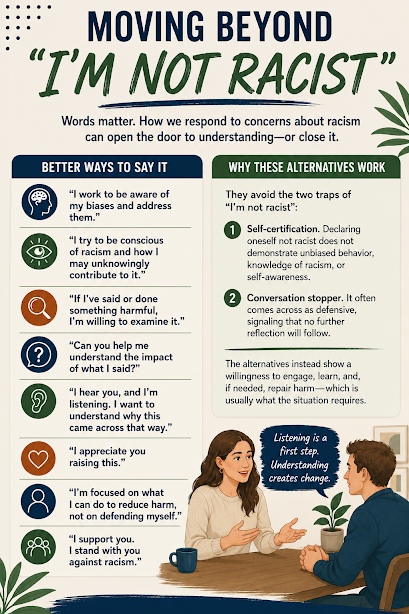
Below are suggestions to capture the intended meaning of "I'm not racist" without triggering defensiveness or sounding like self-exoneration.
The phrase "I'm not racist" often shuts down conversation rather than demonstrating accountability or a willingness to engage.
"I work to be aware of my biases and address them."
"I try to be conscious of racism and how I may unknowingly contribute to it."
"If I've said or done something harmful, I'm willing to examine it."
"Can you help me understand the impact of what I said?"
"I hear you, and I'm listening. I want to understand why this came across that way."
"I appreciate you raising this."
"I'm focused on what I can do to reduce harm, not on defending myself."
"I support you. I stand with you against racism."
Why These Alternatives Work
They avoid the two traps of "I'm not racist":
1. Self-certification. Declaring oneself not racist does not demonstrate unbiased behavior, knowledge of racism, or self-awareness.
2. Conversation stopper. It often comes across as defensive, signaling that no further reflection will follow.
The alternatives instead show a willingness to engage, learn, and, if needed, repair harm, which is usually what the situation requires.
References
Bonilla-Silva, E. (2018). Racism without racists: Color-blind racism and the persistence of racial inequality in America (5th ed.). Rowman & Littlefield.
DiAngelo, R. (2018). White fragility: Why it's so hard for White people to talk about racism. Beacon Press.
Kendi, I. X. (2019). How to be an antiracist. One World.
Sue, D. W., Capodilupo, C. M., Torino, G. C., Bucceri, J. M., Holder, A. M. B., Nadal, K. L., & Esquilin, M. (2007). Racial microaggressions in everyday life: Implications for clinical practice. American Psychologist, 62(4), 271–286. https://doi.org/10.1037/0003-066X.62.4.271
Tatum, B. D. (2017). "Why are all the Black kids sitting together in the cafeteria?" And other conversations about race (20th anniversary ed.). Basic Books.