Ivonics, Not Ebonics

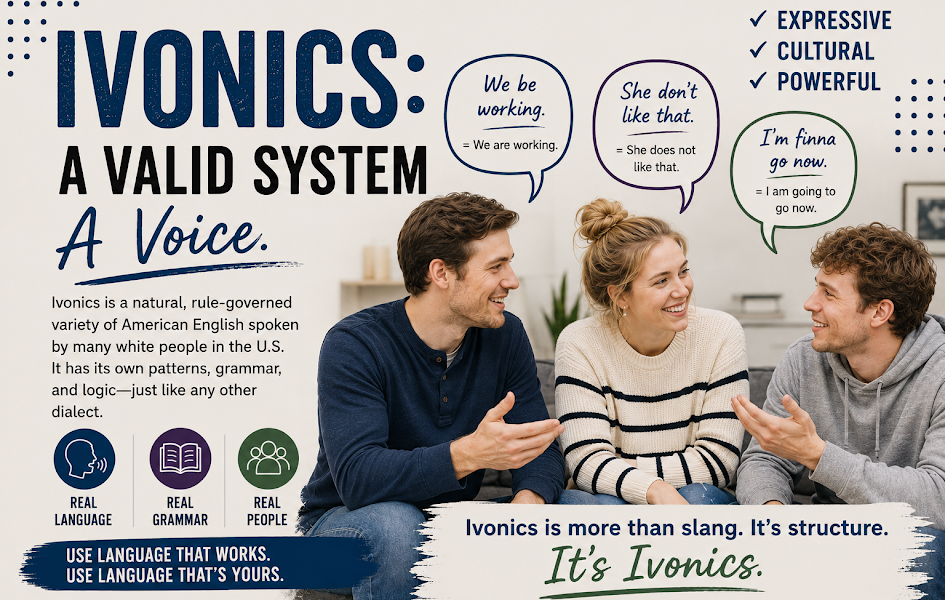
I disagree with the notion that American Blacks like me speak and write a separate, different language from English, historically called “Black English,” and also called “Ebonics,” “Black Vernacular English,” and “African American Vernacular English (AAVE).” I disagree with the notion that the speech differences found among some American Blacks are even a “language” (McWhorter, 1998). Language is not based on race, but on place. Human beings speak the same language as the place in which they are reared. Obviously, that's why we don't hear the same speech patterns of American Blacks among Canadian Blacks, English Blacks, Black Scots, and other Black people in English-speaking countries (Poplack & Tagliamonte, 2001).
Contrary to ideology, the speech differences from standard English spoken by some American Blacks originated in the antebellum South, not in Africa (Poplack, 2000; Poplack & Tagliamonte, 2001). Prior to the Civil War, 90 percent of American Blacks resided in the South and learned their speech patterns from white southerners. After the Civil War, through Black migration to northern and midwestern cities, Black people took this regional variety of speech with them (Wolfram & Schilling, 2016). Therefore, Black people who speak this variety are, as a matter of fact, talking like Whites. They are speaking what I'll call in this piece “ivonics,” meaning ivory (white) plus phonics (sounds).
Despite the social, political, and legal gains of the Civil Rights Movement, which I wholeheartedly support, many of the identity and stereotypical problems currently faced by American Blacks also originated in this historical period. During the same time period, the Black Cultural Identity Movement of the Sixties and Seventies labeled any perceived differences between Blacks and Whites as “black culture.” Furthermore, many of these differences were created out of thin air; some were claimed to have originated in Africa when they did not.
For example, Kwanzaa is not a holiday that originated in Africa, but a holiday created by American Black Ron Everett in Los Angeles in 1966 (Karenga, 2008). Ron Everett renamed himself “Maulana Karenga” after creating the holiday. Additionally, most of the so-called “black-sounding names” or “black names” of today are made up. These names did not originate in Africa and have only existed barely before my own lifetime. As a matter of fact, U.S. Census data of American Blacks and American Whites confirm that there were no discernible or significant differences between the names Blacks had and the names Whites had until the Sixties (Fryer & Levitt, 2004). Prior to the Black Cultural Identity Movement, on paper one could not tell from someone's name whether that person was an American White or an American Black (Fryer & Levitt, 2004). Furthermore, so-called “black names” like “Monique” or even “Keisha” are found among white southerners, probably for similar historical reasons. Most of the people who don't write or speak standard English are white, not black, since White people are still two to three times the population of all other nonwhite racial groups in the aggregate. When a white person uses a nonstandard variety of speech, it has not been called “white English” or “ivonics.” However, when a Black person uses a nonstandard variety of speech, it is sometimes called “Black English,” etc. Obviously, this treats groups differently.
I believe the notion of “Black English” will eventually go away as Black people become more accepted in society. Facts should trump ideology. Facts and history teach us that what “blackness” supposedly is changes over time and from place to place. “Not black enough” one day is “too black” tomorrow. Let's use facts, critical thinking, and reasoning; and let's stop being ideological and dogmatic.
References
Fryer, R. G., Jr., & Levitt, S. D. (2004). The causes and consequences of distinctively Black names. The Quarterly Journal of Economics, 119(3), 767–805. https://doi.org/10.1162/0033553041502180
Karenga, M. (2008). Kwanzaa: A celebration of family, community and culture. University of Sankore Press.
McWhorter, J. H. (1998). The word on the street: Fact and fable about American English. Plenum.
Poplack, S. (Ed.). (2000). The English history of African American English. Blackwell.
Poplack, S., & Tagliamonte, S. (2001). African American English in the diaspora. Blackwell.
Wolfram, W., & Schilling, N. (2016). American English: Dialects and variation (3rd ed.). Wiley-Blackwell.