I've Seen That Before: Tropes, Archetypes, and Memes, and the Iterative Nature of the Human Experience

A Familiar Scene
The love-struck man races down the highway. He desperately pursues his romantic interest through a crowded airport (sprinting past rigid, post-9/11 TSA security) at the last minute before she boards the next flight to Paris and exits his life forever! Many years ago, the woman (formerly a shy, frumpy bookworm from small-town Iowa) transformed into a drop-dead gorgeous prom queen and then, after graduating college, moved to Manhattan. She secured a $500,000-a-year position as a magazine writer’s assistant, rented a 3-bedroom apartment, and had plenty of existential anxiety around what she should “like…do with, like, her life!” Her male roommate, who was either gay or in the “friend-zone,” had total faith in her! She’d certainly find true love and achieve all her wildest dreams!!
Meanwhile, a bunch of bad guys patiently wait their turns to attack a reluctant hero who is just 10 minutes away from retirement. When they fire their weapons at him, however, none of them can hit the broad side of a barn. They’ve twice thrown this hero off a skyscraper. The first time, the roof of a car broke his fall, and the second time, he landed in a kiddie pool (suffering no injuries).
This reluctant hero has a teenaged son. His son is friends with a bunch of sex-crazed teens who split up inside a shadowy home to avoid an ax-wielding serial killer. Creepy dolls and disturbing, crayon-drawn child sketches appear everywhere, and housecats provide the dumb teens with random jump scares. The dumb teens venture into dark basements or hide under beds and in closets. When the killer pursues them, they either trip over themselves or fail to start their car engine(s).
One of these teens has an older brother who is in the military. His older brother- during the fog of war- pulls a grenade pin out with his teeth and tosses his grenade into enemy territory. The explosion that follows is fiery and enormous. The soldier maintains his resolve. His lieutenant, after all, had given a rousing speech before the battle: “What we do in life echoes in eternity, and they will NEVER take our FREEDOM!!”
This soldier (whose wife is probably quite sexy) has children back home. These children (a quarterback, a cheerleader, and a mathlete) come downstairs every morning to a full, hotel-grade continental breakfast (with bacon, pancakes, French toast, tater tots, oatmeal, scrambled eggs, and Belgium waffles). They don’t, however, sit down to eat. They take a few bites and then scurry outside to their school bus (which picks them up right in front of their house). They then head to a high school where every student (freshman to senior) looks like they’re in their 30s. One of the kids will throw a huge party at his parents’ multimillion dollar mansion this weekend. This mansion includes a pool and a gazebo (where one of the students will pass out drunk and the other will finally lose his virginity!).
Most of these students’ parents work as top-secret governmental spies at agencies where they can routinely hack into any system in a matter of seconds. Their mornings are never complete without a sweeping view of the American National Mall (in Washington DC) and a cryptic phone call that neither begins with “hello” nor ends with “goodbye.”
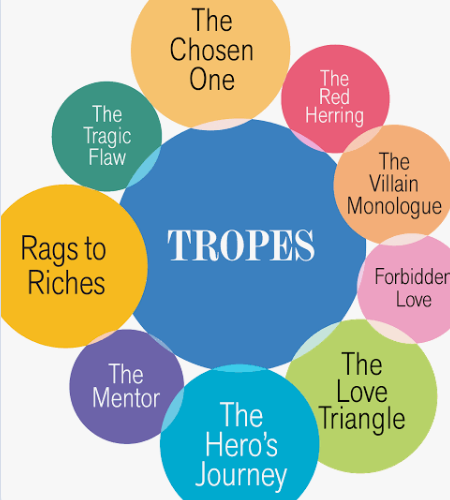
Watch enough films or television shows, and you’ll encounter plenty of these “cliches.” However, they are more commonly referred to as “tropes,” and they can be found throughout all forms of storytelling, art, entertainment, media, and even real life.
The intriguing thing about tropes is how greatly they vary. Some tropes are endearing, while others are annoying. Some tropes are situational, while others are foundational. Some tropes apply to characters, while others apply to narrative devices/formats.
Character Focus
Consider for instance, the following stock characters: the reluctant hero (Bilbo Baggins from The Hobbit, Luke Skywalker from the Star Wars franchise, Harry Potter from the eponymous Harry Potter series, e.g.), the sidekick (Samwise Gamgee from the Lord of the Rings series, e.g.), the villain (Hannibal Lecter from The Silence of the Lambs, Norman Bates from Psycho, e.g.), the mean girl (Regina George from Mean Girls, e.g.), the jock (Nate Jacobs from Euphoria, e.g.), the bully (Biff Tannen from the Back to the Future series, e.g.), the femme fatale (Phyllis Dietrichson from Double Indemnity, e.g.), the hard-boiled detective (Philip Marlowe from The Big Sleep, e.g.), the comic relief (Timone and Pumbaa from The Lion King, e.g.), and the good king (Aragorn from The Return of the King, e.g.). These are what storytellers and psychologists commonly refer to as archetypes (more on them later). Plenty of highly peculiar character sub-types abound, though.
Comedy, for instance, has given us the “bumbling dad” (Homer Simpson from The Simpsons, Clark Griswald from the National Lampoon franchise, Peter Griffin from Family Guy, e.g.), the “Deadpan Snarker” (April Ludgate from Parks and Rec, e.g.), the “Depraved Dentist” (Tim Whatley from Seinfeld, e.g.), the “Stupid Crook(s)” (Harry and Marv from Home Alone, Jasper and Horace from 101 Dalmatians, e.g.), and the “Unsatisfiable Customer” (Melvin Udall from As Good As It Gets, e.g.). Just to name a few.

Brad Bird’s 2004 animated family flick, The Incredibles, notably features the “action dad” and “action mom” in the form of Bob Parr (Mr. Incredible) and Helen Parr (Elastigirl). The “action girl” (Hit-Girl/Mindy McCready from Kick-Ass, Arya Stark from Game of Thrones, Eleven from Stranger Things, e.g.) is a trope that many people either roll their eyes at or can’t get enough of! The “bad ass driver” is a favorite amongst fans of action films like Bullitt, Drive, Baby Driver, Logan Lucky, and the Bond & Bourne franchises. The “Plucky Middie,” a young, brave teenager aboard a sailing ship (Blakeney and Calamy from Master and Commander: Far Side of the World, e.g.) is one of those character tropes most of us likely didn’t even know had a name. The “Magnetic Hero” (Morpheus from The Matrix, Jack Sparrow from the Pirates of the Caribbean franchise, e.g.), the “Underling” (Darth Vader to Emperor Palpatine, e.g.), and the “Damsel in Distress” (Ann Darrow from King Kong or Honey Rider from Dr. No, e.g.), however, are far more common!
Horror films certainly have their own fair share of character tropes. The “Ax Crazy” murderer (Leatherface from The Texas Chainsaw Massacre or Jason Vorhees from the Friday the 13th franchise, e.g.), the “Wicked Witch” (Elphaba from The Wizard of Oz, Aunt Gladys from Weapons, and Maleficent from Sleeping Beauty, e.g.), the “Mad Scientist” (Viktor Frankenstein, e.g.), the “Killer Toy” (Chucky, e.g.), vampires, werewolves, ghosts, goblins, demons, devils, mummies, and zombies are all classic examples. But lesser-known tropes, including “Nazi Zombies,” “Occultic Detectives,” “Vampiric Sex Gods” (Eric and Bill Compton from True Blood, e.g.), “Horror Hippies” (the free-loving pagans from Summerisle in The Wicker Man, e.g.), and “Civilization Destroyers” (the Night King from Game of Thrones, e.g.) also abound throughout the horror genre.

Romantic comedies (“rom coms”) and dramas have given us the helpless romantic (Lloyd Dobler from Say Anything, Dorothy Boyd from Jerry Maguire, and Tom Hansen from 500 Days of Summer, e.g.), the best friend (Marie from When Harry Met Sally, George from My Best Friend’s Wedding, e.g.), and the rival love interest (Zachary “Sack” Lodge from Wedding Crashers, e.g.). But perhaps the best way of looking at rom com/drama character tropes is to look at the types of pairings they give us. The “Grumpy/Sunshine Pairing,” for example, can be found in the characters of Rick (Walton Goggins) and Chelsea (Aimee Lee Wood) from The White Lotus (third season). The “Billionaire/Out-of-Touch Lead” and the “Pauper” is the type of romance that viewers find in Pretty Woman or 50 Shades of Gray. Meanwhile, characters like Margaret Tate from The Proposal, Jane Altman from 27 Dresses, and Tess McGill from Working Girl would all fall into the “workaholic/career-driven romantic” type. Rom coms also give us several tried-and-tested character dynamics- “Enemies to Lovers” (10 Things I Hate About You, e.g.), “Best Friends Turned Lovers” (When Harry Met Sally, e.g.), “Fake Daters” (The Proposal, e.g.), and “Makeover Subjects” (Laney Boggs from She’s All That, e.g.).
Plenty of other genres are, of course, jam-packed with character tropes- wizards and sorcerers in fantasy (Gandalf from The Lord of the Rings, e.g.), the “voice of reason” in science fiction (Dr. Ian Malcom from Jurassic Park, e.g.), the “speech-giver” in war films (William Wallace from Braveheart, e.g.), and the “underdog” in sports movies (the Average Joe’s from Dodgeball, e.g.). Just to name a few. But one of the other most notable and pervasive types of tropes are situational ones. Character decisions and behaviors, settings, props, and narrative beats are often replicated!
Setting the Scene
In the world of comedy, for instance, a character might try to behave naturally but come off as weird. That…or they may whistle to appear innocent (when everyone can see right through their façade). Characters working at an assembly line accidentally make a huge mess when they drastically increase the conveyor belt’s speed. Someone fires a novelty gun and a flag that literally reads “BANG!” appears instead of a bullet. A male character is covered in lipstick stains to signify that someone kissed him all over, an enthusiastic person who can’t read the room “treats” someone to their incredibly boring vacation slides, and one character predicts what another will do with clockwork precision. Chirping crickets emphasize dead silence and a person’s unfunny joke. A cartoon character might accidentally sit/land on a cactus, walk off the side of a cliff, or literally cry a river/ocean. The “chew-out, fake-out” is a peculiar trope- a character looks like they’re going to reprimand someone (employee, child, etc.) for something they did but then instead praises them. The cutaway gag is one of Seth Macfarland’s favorite tropes on Family Guy, while The Fresh Prince of Bel-Air has certainly favored the “defenestration” gag (various characters toss Jazz out the front door).

A slapstick, “drop-in character” like Cosmo Kramer (from Seinfeld) slams into a door or bonks his head on an overhead counter, while his partner in crime, Newman, steals a “pie from a windowsill.” “Disproportionate retaliation” is another one of those tropes you may not have known had a name (e.g., George Costanza from Seinfeld demands that a car dealership employee who allegedly stole an “extra” vending machine Twix bar apologize, return his money, and lose his job). Its sister trope, “disproportionate restitution,” is just as common and as silly (e.g., “I’m sorry I totaled your car. Here’s a $15 Starbucks gift card”). The American version of The Office, which has churned out plenty of internet memes, is perhaps best known for the trope in which Michael Scott cries out “No! No! No! Oh God! No!” The “pre-emptive ‘shut up’” and the “I’m all ears…on second thought, don’t tell me” tropes provide plenty of comedic flavor, while gender and sex-related tropes fall into their own special sub-category. Take, for instance, the man who stares helplessly at a woman’s chest, driving her to “gently remind” him: “My eyes are up HERE!” Or…two characters who apparently share no attraction suddenly wake up next to one another after a night of heavy drinking (e.g., Niles and Lilith on Frasier).
Action/adventure relies on its own set of time-tested tropes to keep the tension, adrenaline-pumping thrills, and suspension high. Want to raise the stakes? During the climactic showdown, slowly starve the hero of oxygen (Mark Watney in The Martian, Tony Stark and Nebula in Avengers: Endgame, or Robert Langdon in Angels & Demons, e.g.). A ticking clock, timebomb, or slowly disintegrating building, dam, or underwater tunnel should also certainly ratchet up the tension. Action/adventure characters might “climb, slip, hang, and then climb again,” as Ethan Hunt (scaling a mountainside) does in the opening sequence of Mission Impossible: II, avoid detection by clinging to the roof of a hallway or ceiling (Peter Parker in Spider-Man, e.g.) or catch a bullet midair to instantly show how “badass” they can be (e.g. Neo from The Matrix). The badass hero might also light a fuse with a cigar, tear out a bullet lodged in his chest with his bare hands, or blow up an automobile by firing a single gunshot into its gas tank. The “Hallway Fight” is yet another common action-adventure trope (see Inception, Kill Bill: Volume 2, Oldboy, Marvel’s Daredevil, and The Matrix, e.g., for awesome examples of it), as is the fight on top of a mountain, skyscraper, or waterfall.
Let’s not forget that anyone (including Eddie from Stranger Things or Giles from Buffy the Vampire Slayer, e.g.) who can open a hood, grab two wires, and stick them together can hot-wire a car. Certain props appear repeatedly in action/adventure films/shows. Examples include the impromptu zip line (like the ones that James Bond in Moonraker, Ethan Hunt in Mission: Impossible- Ghost Protocol, or Doc Brown in Back to the Future use) the impromptu parachute (the rug that Aladdin or the life raft that Indiana Jones use, e.g.), or a grappling hook gun. Then are also of course plenty of repeated stunts: the hero and the bad guy fight on top of trains (Speed, Skyfall, e.g.), the hero and/or the bad guy leap onto moving cars (The Matrix Reloaded, e.g.), and characters leap across/between buildings.

When it comes to horror, plenty of situational tropes keep viewers terrified. The abandoned campground…the abandoned warehouse…the abandoned hospital…the abandoned playground. Let’s also consider the monster lurking in the dark whose demonic eyes are the only objects that shine (Pennywise from It, e.g.) …the beast in the maze…the ghostly girl who sits on a rusty swing at night…the creaking floorboards…the murderous hitchhikers…the apocalyptic cults, dark swamps, and hordes of zombies. Out of all the genres, horror films certainly take the lion’s share of silly tropes. The clumsy bimbo, the feline jump scare, and the arbitrarily stalling car or emergency phone call that arbitrarily drops are just the tip of the iceberg. Maybe frightened teens shouldn’t split up, but they definitely shouldn’t hide defenselessly under a bed or wander into some strange home and cry out, “Hello? Is anyone there?!” They also should probably trust their intuition and make an immediate U-turn the second they encounter the creepy cemetery (Freddie vs. Jason, Night of the Living Dead, e.g.), the creepy cathedral, the creepy children’s choir (Poltergeist, Children of the Corn, e.g.), the creepy murder of crows, the creepy dollhouse, or the creepy gas station attendant. And should you confront the living, breathing, mortal human killer, “double tap” to make sure he’s actually dead. This trope was so common throughout the 1970s and 1980s that Wes Craven’s classic meta-horror film, Scream (1996), directly referenced it.
All that said, death cults (The Wicker Man, Midsommar, e.g.), demonic possession (The Exorcist, Sinister, The Lazarus Effect, e.g.), characters eaten alive (Jaws, Anaconda, e.g.), ghastly, evil ghosts (Nightmare on Elm Street, Crimson Peak, e.g.), haunted houses & castles (The Amityville Horror, e.g.), headless horsemen (Sleepy Hollow, e.g.), hellish dungeons and portals, sadistic serial killers (Hostel, Saw, The Silence of the Lambs, and Se7en, e.g.), and well-executed jump scares (the shark’s sudden appearance in Jaws, the final hand-grabbing dream sequence in Carrie, and the agonizingly long, unbroken nurse station hallway scene from The Exorcist III, e.g.) are some of horror’s most successful, time-tested tropes.
Situational rom-com tropes are quite easy to summarize. “I can explain.” “It’s not what it looks like.” “I know I just spent an intimate night with someone other than you, but that person meant nothing to me!” And, of course, “I hate her guts…so I’m going to ask her to marry me.” Throw in a boombox, an overpriced coffee shop, and a sweeping skyline view of New York, Chicago, or London, and there you go. You have yourself a successful rom com. Or, if it’s a romantic drama, give one of the leads terminal cancer (Autumn in New York, A Walk to Remember, or The Fault in Our Stars, e.g.).
Narrative Focus
Outside of characters and situations, there are also plenty of common (and not-so-common) narrative tropes. Linear storytelling accounts for most movies, TV shows, theatrical productions, and novels. Non-linear storytelling, however, is less common and more difficult to master. This type of trope is the one people would find watching Pulp Fiction, Amores Perros, or 21 Grams, e.g. Parallel storytelling (which usually either illustrates two similar or diametrically opposite characters) has been written or produced to excellent effect in The Godfather Part II, All the Light We Cannot See, and even Erik Larson’s nonfiction work, The Devil in the White City. The “Rashomon” format (named for Akira Kurosawa’s brilliant, eponymous film from 1950) tells a story by exploring the 1st-person perspective of several characters. Rashomon is, of course, a classic example of this format. But other major contenders include Ridley Scott’s The Last Duel, Vantage Point, and The Handmaiden.
How the story begins constitutes one sub-category of narrative tropes. The “Action Prologue,” in which exciting events occur before the story begins, is a popular one. Most of the James Bond, Lord of the Rings, Harry Potter, X-Men, Star Wars, and Star Trek movies begin this way, as does the first episode of Breaking Bad, Vikings, and Game of Thrones. Dystopian films/shows like The Road, The Book of Eli, and The Walking Dead begin “After the End,” in a post-apocalyptic landscape. Breaking Bad is also one of several stories (including Harry Potter, the Substance, the 6th Day, Lethal Weapon, and Star Trek II: The Wrath of Khan, e.g.) that begins on a person’s birthday. Citizen Kane, Alien, American Beauty, Cape Fear (1991), and Fight Club all begin their stories with “bookends,” while films like The Thing, 12 Angry Men, and Panic Room all begin with a “closed loop” (you’re on your own; no way to get out or receive help). Sometimes movies like Alien or Die Hard will “ease into [an] adventure,” while other times, they begin “in medias res” (Star Wars Episode IV: A New Hope, Game of Thrones, Deadpool, e.g.). Other beginnings include (but are certainly not limited to) the “Framing Device” (Titanic, e.g.), “The Opening Narration” (Goodfellas, e.g.), “The R-Rated Opening” (Y Tu Mama Tambien, e.g.), “The Shipwreck Start” (The Tempest, e.g.), and “You Wake Up in a Room” (Severance, e.g.).
Naturally, how a story ends constitutes another sub-category of narrative tropes. Classic conclusions, such as the rosy “happily ever after” one (Cinderella, Beauty and the Beast, Pinocchio, and Sleeping Beauty, e.g.), “the ambiguous ending” (Inception, Apocalypse Now, Hamilton, The Sopranos, and Heretic, e.g.), in which the viewer is left to their own interpretations, or the “bittersweet ending” (Casablanca, La La Land, Gladiator, and Toy Story 3, e.g.), in which, to paraphrase Mick Jagger, “you can’t always get what you want (but if you try sometimes, you find you get what you need,” are all pretty self-explanatory. The same goes for the “tragic ending” (Hamlet, Saw, Million-Dollar Baby, Se7en, No Country for Old Men, e.g.). But more peculiar ones pervade our vast repertoire of films, shows, plays, and novels as well. The self-explanatory “it was all a dream” ending (The Wizard of Oz, Dallas, e.g.) is, of course, an extremely risky one. The “Big Rock Ending,” in which the characters hammer away a “grand finale” on their instruments (Bill and Ted Face the Music, e.g.) and the “Dance Party” ending (Barbie, Austin Powers: The Spy Who Shagged Me, e.g.) are unique “feel-good” conclusions. The “Cruel Twist Ending” (Buried, Black Mirror, Drag Me to Hell, Occurrence at the Owl Creek Bridge, e.g.), meanwhile, seems to enjoy intentionally and exclusively torturing its viewers/readers. Other conclusions include (but certainly are not limited to) the “Win-Win Ending,” the “Epilogue Ending,” “The Stinger” (when a scene plays after the credits), the “Photo Montage,” the “Nested Story Reveal” (How I Met Your Mother, Little Women, e.g.), and the “Moving Away Ending” (Lady Bird, Friends, e.g.).
Narrative beats are also quite iterative across films, TV shows, plays, novels, and stories in general. “Anticipation” creates an expectation of something awesome in the works. “Pipes” lay subtle foreshadowing clues into the groundwork of the story. The “Reveal” cashes in on the suspense that the story builds up, the “Bringdown” rubs salt into the viewer or reader’s wounds, and the “Gratification” does the exact opposite (giving the viewers/readers exactly the kind of payoff that they’ve been wishing and waiting for).
Classical Tropes
Accent tropes…expositional tropes…symbolic tropes…title and title sequence tropes. Tropes nested within tropes. Do tropes exist beyond the page, the screen, and/or the stage? Absolutely! If we turn the clock back as far as humanity goes, we find that cave paintings were one of the earliest tropes: abstract symbols carved onto the Blombos Cave in South Africa (c. 70,000 B.C.E.), hand stencils and disks that appear in the caves of El Castillo in Cantabria, Spain (c. 39,000 B.C.E.), figurative red animals in Fumane Cave, Italy (c. 35,000 B.C.E.), up to 2,000 complex images that appear in the Lascaux Cave (France) (c. 17,000 B.C.E.), cave art in Altamira (c. 15,000–12,000 B.C.E.), outdoor rock art in Tassili-n-Ajjer, Algeria (c. 10,000 B.C.E.), and the “Cave of the Hands” in South America (c. 7300 B.C.E.)[1] Although sub-Saharan humans as far back as 100,000 B.C.E. developed methods of mixing pigments by using ochers (earth pigments that contained iron oxide), charcoal, and bones (mixed with saliva and animal fats), the vast majority of all this cave art didn’t appear until the “Upper Paleolithic” (40,000–10,000 B.C.E.), an era in which Homo sapiens became the predominant human species on earth (replacing the western European Neanderthals) [1]!
Fertility figures, such as the Woman of Willendorf (c.25,000 B.C.E.), the so-called mammoth ivory “Lion Man” figure from the Hohlenstein-Stadel Cave in Germany (c.40,000 B.C.E.), the earliest “Venus” figurines from the Hohle Fels cave in southern Germany (40,000–35,000 B.C.E.), the ceramic Venus of Dolní Věstonice (Moravia) figurine (29,000–25,000 B.C.E.), the ivory Venus of Brassempouy in France (c.23,000 B.C.E.), the red ocher, sexually explicit Venus of Laussel bas-relief (c.20,000 B.C.E.), and the terra-cotta Seated Woman of Çatalhöyük statuette from Anatolia (Turkey) (6,000 B.C.E.) represent another set of early sculptural tropes [2]. One could even sub-categorize these tropes. A Venus figurine’s charms or amulets were supposed to encourage fertility and ward off evil spirits [3]. Many of these figures were explicitly erotic, or they celebrated female sexuality within a matriarchal society [3]. It was also an ancient trope that stone figurines functioned as simple dolls or playthings [3].
One of the key “tropes” of the Greek sculpting was the “ideal human figure.” In the 6th-5th century B.C.E., for instance, statues depicting young men and draped women (kouroi and korai, respectively) were made [4]. The male figures were depicted in the nude [5]. The sculptor designed their bodies as stiff and nearly symmetrical [5]. The enigmatic “Archaic smile” was one of the most salient “tropes” of the Archaic period [5]. During the Early Classical period (480–450 B.C.E.), the Greeks produced statues in natural poses (with their heads turned slightly, a severe/serious expression, and an absence of any decorative features) [5]. The contrapposto pose of the Kritios Boy (a nude figure found in Athens, Greece) marked the beginning of a more realistic sculpting style [4]. The High Classical period (450–400 B.C.E.) gave us statues in more relaxed poses (with increased anatomical accuracy and detailed draperies) [5]. It was during this period that Phidias completed his colossal statue of Zeus on his throne for the temple of Olympia [4]. During the Late Classical period (400–323 B.C.E.), artists added greater realism to the statues’ facial expressions and poses [5]. They also smoothed and softened their figures and gave them sensuous lines [5]. One of the “Late Classical” tropes was an emphasis on elegance, and one example of that was Praxiteles’ Aphrodite of Knidos (360–330 B.C.E.), a real woman with rounded limb and soft-looking flesh [5, 6].

Ancient/classical and medieval history is littered with archaic tropes. Consider, for instance, the “Reclining Buddha,” the “Seated Buddha,” the “Standing Buddha,” the equestrian “war hero” statues, Byzantine aesthetics, “Christ humanized,” illuminated manuscripts, Celtic imagery, Islamic geometric designs, the “divine light” that permeates stained-glass cathedral windows, the “lives of saints,” altarpieces, and triptych panels. The “vanishing point” and other principles of linear perspective, the “Grand Manner” style of Raphael, Pietro Perugino, and Giovanni Pietro, and the “female nude” (The Birth of Venus by Sandro Botticelli, c. 1484, e.g.) are some of the quintessential Renaissance tropes. And then there are, of course, plenty of tropes that transcend paintings and sculptures. Let’s consider, for instance, Johann Sebastian Bach’s use of “counterpoint” in classical music, Shakespearean comedies that involve cross-dressing and mistaken identity, and even the non-artistic, political allusions to classical antiquity that American founding fathers like Alexander Hamilton, James Madison, and Thomas Jefferson made in their written works.
The word trope is derived from the Greek word, trópos, meaning “way,” “direction,” “style,” or “turn.” But perhaps another way to think of a trope is to think of it as a pattern. It is something that repeats. It’s iterative. It persists, and it will persist as long as people allow it to persist for the same reason that any organism or evolutionary adaptation persists- natural selection and the survival of the fittest. Some philosophers, however, believed that these ideas and patterns existed beyond our natural world. Plato, for instance, proposed the concept of “forms”- shadows of a higher, eternal realm of absolute ideals (beauty, love, justice, circularity, truth, wisdom, and logic, e.g.)
Freud, Jung, and Dawkins
Swiss psychiatrist Carl Jung developed the brilliant concept of “archetypes,” which added plenty of rich, emotional depth and dimensionality to Plato’s “forms.” Jung, a talented linguist and polyglot from an educated family, brought his eclectic eccentricities (including his mastery of Sanskrit) and emotional intuitions into his work [7]. Jung trained in psychiatry but transitioned to psychoanalysis after meeting Sigmund Freud (1907) [7]. Jung became Freud’s heir apparent, but the two unfortunately grew estranged over theoretical differences and never met again [7]. Jung traveled widely across Africa, the United States, and India (following World War I) [7]. He studied native people and participated in various archaeological/anthropological expeditions [7]. In 1935, though, he returned to Switzerland, where he taught at the University of Zurich and then pursued research [7].
To understand Jung, though, we must first get a sense of his mentor, Austrian (Viennese) psychoanalyst Sigmund Freud. Freud, who was influenced by French neurologist Jean-Martin Charcot, initially introduced the idea that the inner workings of our mind (not the forces of God or fate) guide us [8]. Freud took note of Charcot’s conclusion that hysteria was a neurological disorder, and Joseph Breuer’s observation that hysteria symptoms attenuated as his patients described their fantasies and hallucinations (Breuer was one of Charcot’s colleagues) [8]. Breuer and Freud teamed up to write Studies in Hysteria (1895), in which they both claimed to have found a way to release repressed memories from the unconscious, allowing the patient to consciously recall a memory and confront the experience, both emotionally and intellectually [8]. “Our operational mind of, which we are directly aware of in our everyday experience, is just a fraction of the total psychological forces at work in our psychical reality,” Freud argued [9]. “The poets and philosophers before me discovered the unconscious; what I discovered was the scientific method by which it could be studied”
Freud thought of the “conscious,” “pre-conscious,” and the “unconscious” as an iceberg. The “id” is the lowest and most primitive part of us. The “ego,” which sits atop the “id,” mediates between our most basic impulses and our most restrained, intellectual “super-ego.” The “id” (i.e. “unconscious”) is (for better or worse) the place where we retain all our memories, thoughts, and feelings [8]. It is where our biological drives reside and it ultimately sits in the “driver’s seat” [15]. Our unconscious acts as a receptacle for ideas or memories that are too powerful, too painful, or otherwise too much for the conscious mind to process [10]. Certain ideas or memories (and their associated emotions) that threaten to overwhelm our psyche are split apart from the memories that our conscious mind can access and are instead stored in the unconscious [10].
In 1903, French physiologist/physician Pierte Janet supplementarily suggested that traumatic incidents generate emotionally charged beliefs, which influence an individual’s emotions and behaviors for many years [15]. Unfortunately (along those lines), to paraphrase comedian Robin Williams, the unconscious is like an oscillating “Jack-in-the-Box” that mockingly proclaims that “I’m not going anywhere” and will not simply bury our memories (Williams’ joke was actually about male erections, which, in terms of Freudian psychology, is deeply relevant).
Freud was influenced by the physiologist Ernst Brücke, whose “new physiology” sought to provide mechanical explanations for all organic phenomena [10]. Ernst Brücke applied the Law of the Conservation of Energy (stating that the total amount of energy in a system stays constant over time; it cannot be destroyed, only moved or transformed) to human beings [10]. Freud and Brücke both concluded that “psychic energy” (the majority of which resides in the unconscious) can undergo modification, transmission, and conversion, but, like inorganic energy, cannot be destroyed [10]. If we have a thought that our conscious mind finds unacceptable, our mind will redirect it away from conscious perception into the unconscious, in a process Freud called “repression” [10].
Freud’s investigation ultimately led to the idea that sex and anger were two of the most repressed feelings, and that disorders like alcoholism, anxiety, and depression arose as byproducts of those repressed feelings. The hilariously ubiquitous notion of the “Freudian slip” emerged as a result (a man watches a show with a beautiful buxom woman and “accidentally” tells his wife it was the “breast” show he’s ever seen, e.g.).
Jung took Freud’s ideas further, delving into the elements that make up the unconscious [15]. Societies across the world- the Chinese, Indian, Persian, Scandinavian, Irish, Navajo, Māori and others alike- share certain striking similarities [15]. These similarities have held true for thousands of years in the form(s) of myths and symbols [15]. These shared myths, Jung concluded, are held in a timeless, trans-cultural structure known as the “collective memory” (a.k.a. the “collective unconscious”) [15]. The collective unconscious is different from Freud’s individualistic notion of the unconscious (with its own unique array/concatenation of memories, prejudices, opinions, beliefs, and inclinations). Sigmund Freud even explored the nature of the unconscious and dream symbolism in The Interpretation of Dreams (1899) [15]
The “collective unconscious,” however (Jung argues) is driven by the hereditary memories of humanity (writ large) [15]. They are passed from generation to generation, and they change only slightly in their attributes across different cultures and time periods [15]. However, they emerge as inherited memories in the form of the language of symbols- i.e. “archetypes” [15].
“Archetype” is derived from the Latin word “archetypum,” which translates as “first molded,” and Jung indeed believed that archetypes are memories from the experiences of our first ancestors [12]. Archetypes act as templates within the psyche that we use unconsciously to organize and understand our own experience(s) [12]. Jung thought of them as inherited emotional/behavioral patterns [12]. Although we may fill in the gaps with details from our individual lives, this preexisting substructure in the unconscious allows us to make sense of our experience [12]. And, more importantly, we can unify our emotional/behavioral patterns [12]. This unification can be divided into three separate components- the ego, personal unconscious, and collective unconscious [12]. The ego represents the conscious mind or self [12]. The personal unconscious contains a person’s memories, including those that have been suppressed, and the collective unconscious is the part of the psyche that houses the archetypes [12].

Archetypes can mold and blend into one another (even across vastly different cultures). We can recognize an archetype easily and instantly [12]. The most highly recognizable ones include The Wise Old Man (Merlin, Gandalf, e.g.), The Goddess (Athena, Aphrodite, e.g.), The Madonna (The Virgin Mary, e.g.), the Great Mother (real-life figure Sojourner Truth, e.g.), and The Hero (Batman, e.g.).
Jung recognized early in his own life that he tended to share only a certain part of his personality with the outside world, and he referred to this superficial vanguard as the “persona” [12].
The next category, and arguably the most controversial by 21st century standards, is that of the “Animus” and “Anima.” The “Animus” is the hyper-macho field commander, Don Juan, or cool logician [13]. The “Anima,” by contrast, is spontaneous, intuitive, and close to nature [13]. The “Anima” views the world horizontally (not vertically). Eve…Helen of Troy…Marilyn Monroe…Sydney Sweeney; they all epitomize the “Anima.”
The “Shadow,” all the secret or repressed thoughts and the shameful aspects of our character, is the archetype that comes the closest to Freud’s notion of “repression.” Although the “Shadow” may represent aspects that we choose to suppress only because they are unacceptable in a particular situation, it is often viewed as one’s “dark side.” The Devil…Mr. Hyde…Heisenberg (Breaking Bad).
Jung’s “True Self,” the central, organizing archetype that attempts to harmonize all other aspects into a unified, whole self, is the most important one [13]. The real goal of human existence, Jung argues, is to achieve an advanced, enlightened psychological state of being that he refers to as “self-realization” [13]
Jung believed that individual dreams existed in dialogue with the collective unconscious, and the archetypes reflect this [13]. For instance, the Wise Old Man or Woman may be represented in a dream by a spiritual leader, parent, teacher, or doctor [13]. The “Great Mother” may appear as one’s own mother or grandmother. She nurtures, comforts, validates and reassures us (or at least she should!) The “Divine Child” is open to all potentialities. The “Trickster” (Saul Goodman, Loki, Pan, Anansi, Tyrion Lannister, e.g.) exposes the dreamer’s vulnerabilities and plays jokes, preventing the individual from taking himself and his desires too seriously [13].
Archetypes, Jung argued, exist in our minds before conscious thought, and can therefore have an immensely powerful impact on our perception of experience [14]. Preformed ideas pave the way of our unconscious [14]. Much of what we generally attribute to deliberate, reasoned, conscious thinking is already being guided by unconscious activity [14]. In 1949, Joseph Campbell, following in Jung’s footsteps, published Hero with a Thousand Faces, detailing archetypal themes in literature from many different cultures throughout history [15].
Following on the heels of Jung and Plato, British evolutionary biologist, Richard Dawkins, coined the term meme in his pivotal 1976 work, The Selfish Gene. Dawkins proposed the idea of a meme as a cultural counterpart to biological genes. A meme, which is derived from the word “mimesis” (“imitation”), refers to a “unit of cultural information.” This can include anything from a tune (Beethoven’s Ninth Symphony, e.g.), a catchphrase (“May the Force be with you,” e.g.), or a type of fashion (Stilettos, hush puppies, e.g.) to an idea (“all men are created equal,” “pain is a weakness leaving the body,” e.g.). Memes can spread from person to person (just like a virus). Dawkin’s concept of a meme, though, should not be confused with the much-more-watered-down concept of an internet meme (Homer Simpson, Jim Halpert, Sam Elliot, etc.).
Real-Life Tropes
Tropes, forms, archetypes, memes. Another word that perhaps comes to mind is “stereotype.” Stereotypes are generally defined as “fixed, oversimplified, and generalized beliefs or mental pictures about a particular group of people or things.” Common stereotypes include the belief that African Americans disproportionately commit most crimes, that all men are rapaciously dangerous, that Asians are naturally smarter than everyone else, and that women are helplessly irrational/emotional. The common denominator is, of course, that they all rely on Darwinian heuristics, and it’s safe to say that tropes, forms, archetypes, and memes do something similar.
In the world of media, for instance, “advertising disguised as news,” “breaking news interruptions,” “emergency broadcasts,” and “we interrupt this program” are common tropes. Online is worse. The particulars from country to country may vary, but, rest assured, if it’s something involving Covid-19, U.S. presidential elections, racism, immigration, religion, or gender, plenty of unoriginal, regurgitated cliches/platitudes will proliferate!
Why do things repeat? Why do we care that things repeat, and why do patterns matter so much to us? Survival is the easy answer; survival and reproduction. But that’s also a reductionistic answer (and an unsatisfying one at that). Why should it matter, for instance, that it’s healthy to exercise and eat certain fruits and vegetables (and therefore, I should make a habit of both exercising and eating healthily)? I’m going to die either way. What does it matter? Why should I eat pizza or drink coffee? Why should I watch Netflix? Because I enjoy it?
At some foundational level, the answer is yes and it defies all rationality…I do the things I do…you do the things you do…we all do the things that we do (and especially the things that we want to do) because…well… we want to do them. We believe that there’s something good and noble (or at least satisfying/pleasurable) in doing whatever it is that we’re doing, and that reason alone suffices.
That is not to say that our lives are based on meaningless, arbitrary trajectories. Rather, the meaning we derive from our existence is inherently shaped by the unique way in which every single one of our lives unfolds and unravels. Our lives, however, don’t unfold or unravel arbitrarily. Not only do our deliberate desires and volitions drive the trajectory of our lives, but our trajectories are not incidental. The path we walk…the life we live…none of it is based on some endless string of unprecedented incidents. Patterns drive our lives. If we’re used to standing up for ourselves, we’ll stand up for ourselves. If we’re used to cowering or fawning or fleeing for the hills, that’s exactly what we’ll do until/unless some force (internal and/or external) drives us to do otherwise.
I don’t say any of this to elevate myself. I struggle enormously with the powerful patterns and forces that drive me to do what I do. If I had to guess, I would say that I’m driven by a clinical, obsessive-compulsive need for cleanliness and reassurance and a ravenous desire for enthusiastic approval. Sometimes these patterns and forces push me in the right direction. Sometimes (suffice to say) they don’t! One of my dearest friends- a therapist who specializes in psychodynamics- always encourages me to plunge down into the great depths of my own conscious mind/soul and figure out what patterns/forces underly my life-trajectory! Perhaps another way of framing it, though, is to look at one’s conscious life as a series of real-life “tropes,” “archetypes,” or “memes” that have manifested themselves across time!
SOURCES
1) Bugler, Caroline, Kramer, Ann, Weeks, Marcus, Whatley, Maud, Zaczek, Ian. The Art Book: Big Ideas Simply Explained. Dorling Kindersley Limited (Penguin Random House), 2017. p. 22.
2) Bugler, Caroline, Kramer, Ann, Weeks, Marcus, Whatley, Maud, Zaczek, Ian. The Art Book: Big Ideas Simply Explained. Dorling Kindersley Limited (Penguin Random House), 2017. p. 20.
3) Bugler, Caroline, Kramer, Ann, Weeks, Marcus, Whatley, Maud, Zaczek, Ian. The Art Book: Big Ideas Simply Explained. Dorling Kindersley Limited (Penguin Random House), 2017. p. 21.
4) Bugler, Caroline, Kramer, Ann, Weeks, Marcus, Whatley, Maud, Zaczek, Ian. The Art Book: Big Ideas Simply Explained. Dorling Kindersley Limited (Penguin Random House), 2017. p. 38.
5) Bugler, Caroline, Kramer, Ann, Weeks, Marcus, Whatley, Maud, Zaczek, Ian. The Art Book: Big Ideas Simply Explained. Dorling Kindersley Limited (Penguin Random House), 2017. p. 39.
6) Bugler, Caroline, Kramer, Ann, Weeks, Marcus, Whatley, Maud, Zaczek, Ian. The Art Book: Big Ideas Simply Explained. Dorling Kindersley Limited (Penguin Random House), 2017. p. 41.
7) Collin, Catherine, Benson, Nigel, Ginsburg, Joannah, Grand, Voula, Lazyan, Merrin, Weeks, Marcus. The Psychology Book: Big Ideas Simply Explained. Dorling Kindersley Limited (Penguin Random House), 2012. p. 107.
8) Collin, Catherine, Benson, Nigel, Ginsburg, Joannah, Grand, Voula, Lazyan, Merrin, Weeks, Marcus. The Psychology Book: Big Ideas Simply Explained. Dorling Kindersley Limited (Penguin Random House), 2012. p. 94.
9) Collin, Catherine, Benson, Nigel, Ginsburg, Joannah, Grand, Voula, Lazyan, Merrin, Weeks, Marcus. The Psychology Book: Big Ideas Simply Explained. Dorling Kindersley Limited (Penguin Random House), 2012. p. 95.
10) Collin, Catherine, Benson, Nigel, Ginsburg, Joannah, Grand, Voula, Lazyan, Merrin, Weeks, Marcus. The Psychology Book: Big Ideas Simply Explained. Dorling Kindersley Limited (Penguin Random House), 2012. p. 96.
11) Collin, Catherine, Benson, Nigel, Ginsburg, Joannah, Grand, Voula, Lazyan, Merrin, Weeks, Marcus. The Psychology Book: Big Ideas Simply Explained. Dorling Kindersley Limited (Penguin Random House), 2012. p. 94.
12) Collin, Catherine, Benson, Nigel, Ginsburg, Joannah, Grand, Voula, Lazyan, Merrin, Weeks, Marcus. The Psychology Book: Big Ideas Simply Explained. Dorling Kindersley Limited (Penguin Random House), 2012. p. 105.
13) Collin, Catherine, Benson, Nigel, Ginsburg, Joannah, Grand, Voula, Lazyan, Merrin, Weeks, Marcus. The Psychology Book: Big Ideas Simply Explained. Dorling Kindersley Limited (Penguin Random House), 2012. p.106.
14) Collin, Catherine, Benson, Nigel, Ginsburg, Joannah, Grand, Voula, Lazyan, Merrin, Weeks, Marcus. The Psychology Book: Big Ideas Simply Explained. Dorling Kindersley Limited (Penguin Random House), 2012. p.107.