Positive Behavior for Social Media

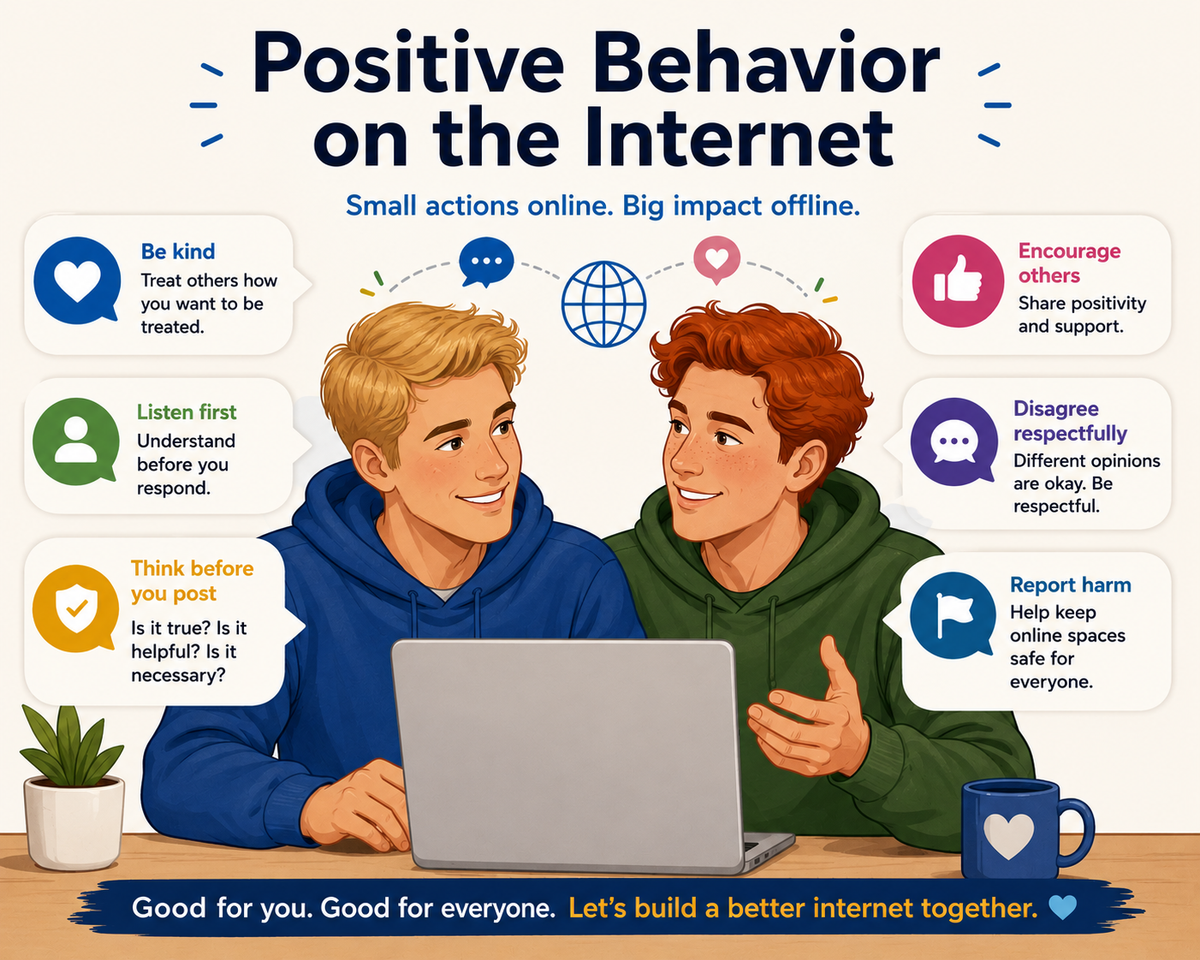
Most positive social media behaviors are direct counters to the well-documented problems with online platforms: engagement-driven amplification, context collapse, echo chambers, and pile-ons. Organized against those four dynamics, plus a set of everyday habits, they look like this.
Countering Engagement-Driven Amplification
The algorithm feeds on your reactions, so the most powerful behavior is withholding them from bad content: don’t quote-post the outrageous take, don’t reply to the rage-bait, don’t hate-share. Every engagement is a vote for more of the same; research shows that posts using moral-emotional language spread significantly farther with each such word added. The positive flip side is deliberately boosting measured, good-faith voices, since sharing is one of the few levers ordinary users have over what travels.
Countering Context Collapse
Read the whole article before sharing it, not just the headline; a large-scale study of link sharing found that the majority of links shared on social media are never actually clicked by the people sharing them. Add context when you post rather than assuming your audience shares your background. Extend charitable readings: interpret ambiguous posts in their most reasonable sense before responding and ask a clarifying question instead of assuming the worst construction. Remember that your post will reach people it wasn’t written for and write accordingly.
Countering Echo Chambers
Follow thoughtful people you disagree with, not the worst representatives of the other side, whom the algorithm will happily supply; exposure to the other side’s most strident voices can actually deepen polarization rather than reduce it. Verify claims through lateral reading, checking what other sources say about a claim before passing it along, rather than trusting whatever arrived in your feed; this is how professional fact-checkers evaluate unfamiliar sources. The caution matters because false news demonstrably travels faster and farther online than the truth. Before criticizing a position, make sure you can state it in a form its holders would recognize.
Countering Pile-Ons and Degraded Conversation
Critique ideas rather than persons. Don’t join dogpiles, even righteous ones; the hundredth reply adds no argument, only punishment. The anonymity and distance of online spaces loosen the restraints people feel face to face, a pattern known as the online disinhibition effect, which is worth remembering about both others’ behavior and your own. Disengage from bad-faith exchanges instead of flaming, and report genuine abuse rather than retaliating. When a conversation turns productive but heated, moving it to direct messages or offline often saves it.
Everyday Habits
Correct your own errors as visibly as you made them. Distinguish clearly between what you know, what you think, and what you’re passing along. Cite sources for factual claims. Be the same person online that you are in a room with people watching. And use the platforms intentionally, on your schedule rather than the feed’s.
A Humanist Framing
The same ethic appears in humanist writing on dialogue across worldview differences. In Humanism from the Heart: Building Bridges Beyond Belief, Steve Ghikadis, drawing on Anthony Magnabosco’s Street Epistemology, argues for conversations built on genuine questions about how people know what they believe rather than on attack, and for connections with others that avoid stereotypes. His summary of the stance, “Evidence is a tool, not a weapon,” captures the meaning of the practices above: verification and empathy work together, and the goal of engaging someone who disagrees is understanding rather than victory. The book addresses dialogue generally rather than social media specifically, but each of its lessons translates directly to online spaces, where a question-first, empathy-forward approach is rarest and most needed.
References
Bail, C. A., Argyle, L. P., Brown, T. W., Bumpus, J. P., Chen, H., Hunzaker, M.
B. F., Lee, J., Mann, M., Merhout, F., & Volfovsky, A. (2018). Exposure to opposing views on social media can increase political polarization.
Proceedings of the National Academy of Sciences, 115(37), 9216–9221. https://doi.org/10.1073/pnas.1804840115
Brady, W. J., Wills, J. A., Jost, J. T., Tucker, J. A., & Van Bavel, J. J. (2017). Emotion shapes the diffusion of moralized content in social networks.
Proceedings of the National Academy of Sciences, 114(28), 7313–7318. https://doi.org/10.1073/pnas.1618923114
Gabielkov, M., Ramachandran, A., Chaintreau, A., & Legout, A. (2016). Social clicks: What and who gets read on Twitter? Proceedings of the 2016 ACM SIGMETRICS International Conference on Measurement and Modeling of Computer Science. https://doi.org/10.1145/2896377.2901462
Ghikadis, S. (2025). Humanism from the heart: Building bridges beyond belief. Foreword by A. Magnabosco.
Suler, J. (2004). The online disinhibition effect. CyberPsychology & Behavior, 7(3), 321–326. https://doi.org/10.1089/1094931041291295
Vosoughi, S., Roy, D., & Aral, S. (2018). The spread of true and false newsonline. Science, 359(6380), 1146–1151. https://doi.org/10.1126/science.aap9559
Wineburg, S., & McGrew, S. (2019). Lateral reading and the nature of expertise: Reading less and learning more when evaluating digital information. Teachers College Record, 121(11), 1–40. https://doi.org/10.1177/016146811912101102