Why Does Dating Interracially Not Prove That One Is Not a Racist

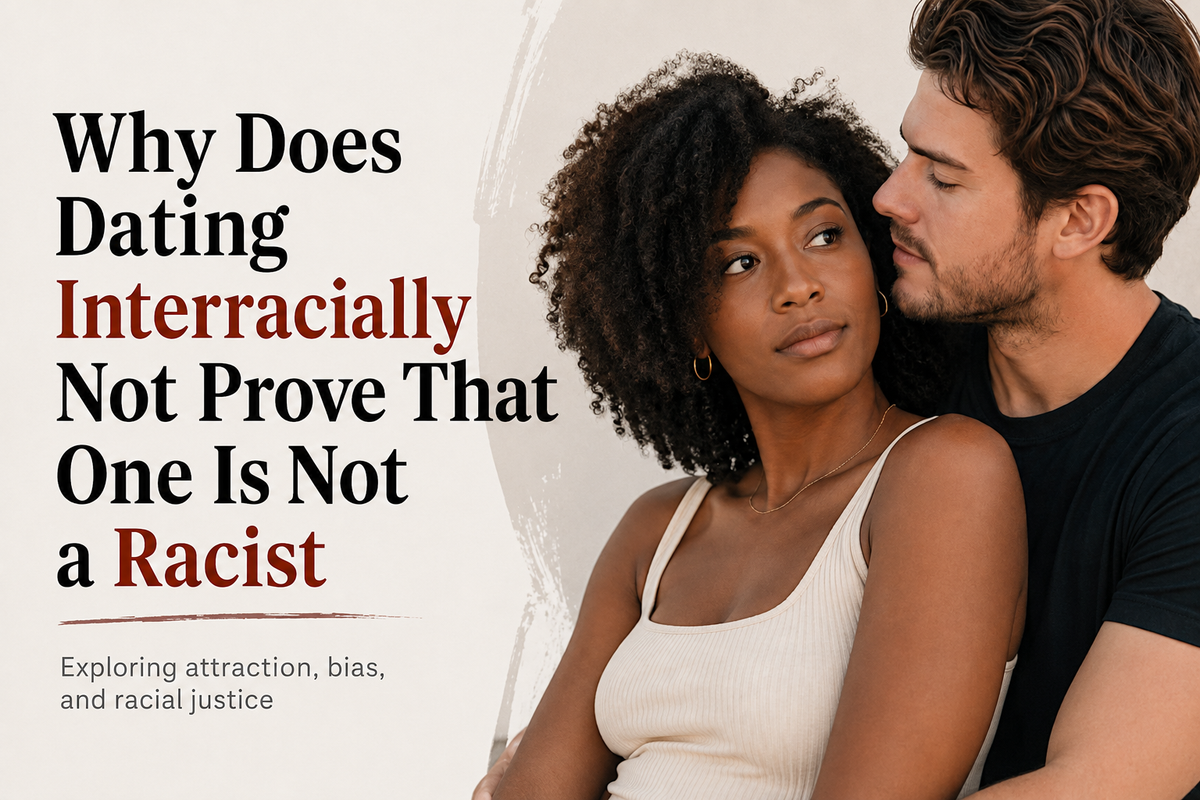
Dating interracially - outside of one's race - does not prove that one is not a racist for many reasons:
Racism is Complex: Racism is a complex and multifaceted issue that goes beyond personal relationships. It includes beliefs, attitudes, behaviors, and institutional structures that perpetuate inequality and discrimination based on race (Bonilla-Silva, 2018). Simply dating someone of a different race does not address or negate these deeper issues.
Implicit Biases: People can hold implicit biases and prejudices even if they are in an interracial relationship (Greenwald & Banaji, 1995). These biases can influence their behavior and attitudes in ways that are not immediately apparent, including in how they view and treat their partner and other people of the same race.
Power Dynamics: Interracial relationships can still involve power dynamics and racial prejudices. One partner might hold prejudiced views or behave in ways that reflect broader societal inequalities, despite their personal relationship (Childs, 2005).
Broader Social Behavior: A person’s behavior in broader social contexts matters. They may exhibit racist behavior or hold prejudiced views in other areas of their life, such as in their workplace, social circles, or in their attitudes towards policies affecting racial minorities (Dovidio & Gaertner, 2004).
Performative Allyship: In some instances, individuals may enter interracial relationships to appear progressive or non-racist without genuinely engaging in anti-racist work or addressing their own prejudices. This performative allyship does not contribute to dismantling racism (Kalina, 2020).
Historical Context: Historically, there have been instances where interracial relationships were used to exert control or dominance over other races, rather than as a demonstration of equality and respect (Pascoe, 2009). This historical context can sometimes inform modern dynamics.
In summary, while dating someone of a different race can be a positive step towards breaking down racial barriers, it does not automatically absolve someone of racist beliefs or behaviors. Anti-racism requires ongoing self-reflection, education, and active efforts to challenge and change prejudiced attitudes and systemic inequalities (Kendi, 2019).
References
Bonilla-Silva, E. (2018). Racism without racists: Color-blind racism and the persistence of racial inequality in America (5th ed.). Rowman & Littlefield.
Childs, E. C. (2005). Navigating interracial borders: Black-White couples and their social worlds. Rutgers University Press.
Dovidio, J. F., & Gaertner, S. L. (2004). Aversive racism. In M. P. Zanna (Ed.), Advances in experimental social psychology (Vol. 36, pp. 1–51). Academic Press.
Greenwald, A. G., & Banaji, M. R. (1995). Implicit social cognition: Attitudes, self-esteem, and stereotypes. Psychological Review, 102(1), 4–27. https://doi.org/10.1037/0033-295X.102.1.4
Kalina, P. (2020). Performative allyship. Technium Social Sciences Journal, 11(1), 478–481. https://doi.org/10.47577/tssj.v11i1.1518
Kendi, I. X. (2019). How to be an antiracist. One World.
Pascoe, P. (2009). What comes naturally: Miscegenation law and the making of race in America. Oxford University Press.