Using "The Bible" Against "Homosexuals"

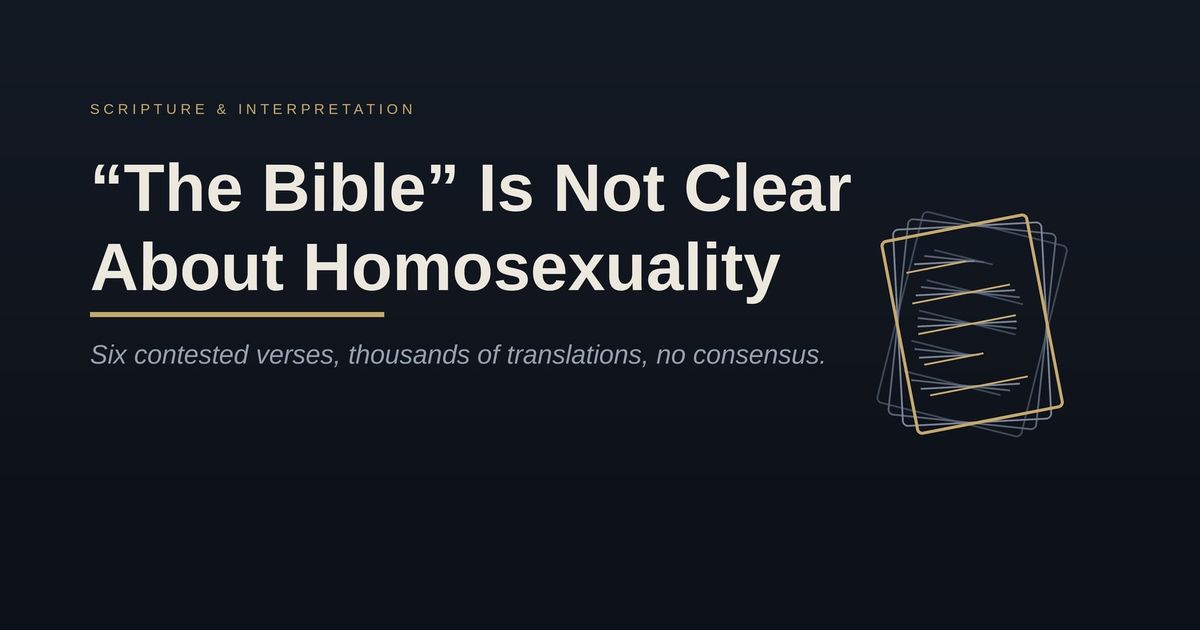
"The Bible" is not clear about "homosexuals" or "homosexuality." Depending on the person making the claim and which version or translation they are using, anywhere from six to 35 verses are claimed to address the topic.
Six verses are typically weaponized against gay people:
Genesis 19:1–11 (Sodom and Gomorrah)
Leviticus 18:22 and 20:13
Romans 1:26–27
1 Corinthians 6:9–10 and 1 Timothy 1:10
"The Bible" is in quotes because there is not just one Bible. There are thousands of versions and translations, and verses supposedly about "homosexuality" are rendered differently across them. The fact that many Christians cannot agree on which verses even refer to "homosexuality" is itself evidence that the text is not clear on the matter. There are 31,102 total verses in the average Bible, showing the text does not treat the subject as a major concern.¹ The verses are ambiguous at best.
Citing these verses selectively, some Christians engage in proof-texting which is the practice of isolating passages from scripture to support a predetermined theological position while ignoring their broader context.
Bible scholars such as Bart D. Ehrman and Dan McClellan, along with many theologians, take a more comprehensive approach to biblical interpretation, considering the linguistic, historical, cultural, and literary contexts of each passage.² This approach can lead to accurate understandings of intended meaning and reduces the risk of misusing scripture to advance a particular agenda and identity.
The writers of scripture, including the Apostle Paul, had no concept of unchosen, fixed sexual orientations such as homosexuality, bisexuality, or heterosexuality.³ These passages are rooted in specific languages, times, cultures, and places. "The Bible" does not address present-day same-sex relationships.
Non-Homophobic Interpretations of the Six Verses
Genesis 19 (Sodom and Gomorrah)
Two angels arrive in Sodom and are greeted by Lot, Abraham's nephew, who invites them into his home. The men of the city surround the house and demand that Lot bring out his visitors so they can rape them. Wanting to protect his guests, Lot offers his daughters instead, but the angels intervene. Recognizing the city's wickedness, the angels instruct Lot to gather his family and flee before the impending destruction. As they escape, the Lord rains down sulfur and fire, destroying Sodom and Gomorrah completely.
Nowhere in this passage does the text say the city is being destroyed because of homosexuality. The "sins" include attempted heterosexual gang rape, misogyny, violence, inhospitality, and the profound misogyny of offering daughters as substitutes.⁴ The men of the town wanted to "know" the angels implying threatened sexual violence.
Leviticus 18:22 and 20:13
Leviticus 18:22: "Do not have sexual relations with a man as one does with a woman; that is an abomination."
This verse, from the Old Testament book of Leviticus, is among the most frequently cited in debates about homosexuality.
Context matters here. Leviticus 18 is part of the Holiness Code, a body of laws written to distinguish ancient Israelites from surrounding cultures, particularly the Canaanites. Many scholars believe this verse addresses ritual sex acts, specifically male-male intercourse as part of Canaanite temple worship — rather than loving, consensual same-sex relationships as the term "homosexuality" is understood today.⁵
The word translated as "abomination" is the Hebrew toevah, which typically denotes ritual impurity or taboo — the same category applied to eating shellfish or wearing mixed fabrics.⁶
Leviticus 20:13
If a man also lie with mankind, as he lies with a woman, both of them have committed an abomination: they shall surely be put to death; their blood shall be upon them." (KJV)
It is also worth remembering that the ancient world had no concept of sexual orientation.³
Romans 1:26–27
King James Version (1611): "For this cause God gave them up unto vile affections: for even their women did change the natural use into that which is against nature: And likewise also the men, leaving the natural use of the woman, burned in their lust one toward another; men with men working that which is unseemly, and receiving in themselves that recompence of their error which was meet."
This verse, written by the Apostle Paul, is frequently cited to condemn homosexuality and homosexuals. Paul was writing to early Christians in Rome and addressing specific practices prevalent in Roman society including temple prostitution, pederasty, and exploitative sexual relationships.⁷ It does not address consensual, loving same-sex relationships as they exist today.
1 Corinthians 6:9–10 and 1 Timothy 1:10
1 Corinthians 6:9–10 lists behaviors Paul associates with those who will not inherit the kingdom of God.
The Greek words Paul uses — malakoi and arsenokoitai — likely referred to specific forms of same-sex conduct, most probably exploitative or coercive ones.⁸
Translations vary considerably:
"Nor effeminate, nor abusers of themselves with mankind" (KJV)
"Male prostitutes, sodomites" (NRSV)
"Homosexuals" (NASB)
"Men who have sex with men" (NIV)
"Sodomites" (NRSV)
"Those who practice homosexuality" (ESV)
"Abusers of themselves with mankind" (KJV)
"Them that defile themselves with men" (ASV)
"Male prostitutes" (NLT)
"Pederasts (adult men who abuse boys)" Jerusalem Bible, German Bibles
Conclusion
Intellectually honest engagement with scripture requires distinguishing between those ancient contexts and the committed same-sex relationships that gay people form in today's contexts. The Bible does not condemn homosexuals (those with a homosexual orientation) and those in same-sex relationships.
Footnotes
- The Holy Bible, standard verse count across canonical texts (31,102 verses).
- Bart D. Ehrman, Misquoting Jesus (2005); Dan McClellan, public scholarship on biblical interpretation.
- Michel Foucault, The History of Sexuality, Vol. 1 (1976).
- Dan McClellan, analysis of Genesis 19 and ancient Near Eastern context.
- Jacob Milgrom, Leviticus: A Book of Ritual and Ethics (2004).
- Brown-Driver-Briggs Hebrew Lexicon, entry for toʿēbah.
- Craig A. Williams, Roman Homosexuality (2010).
- Dale B. Martin, “Arsenokoitai and Malakoi,” Journal of Biblical Literature.