Three Different Gods: Why the Jewish, Christian, and Muslim Gods Are Not the Same God

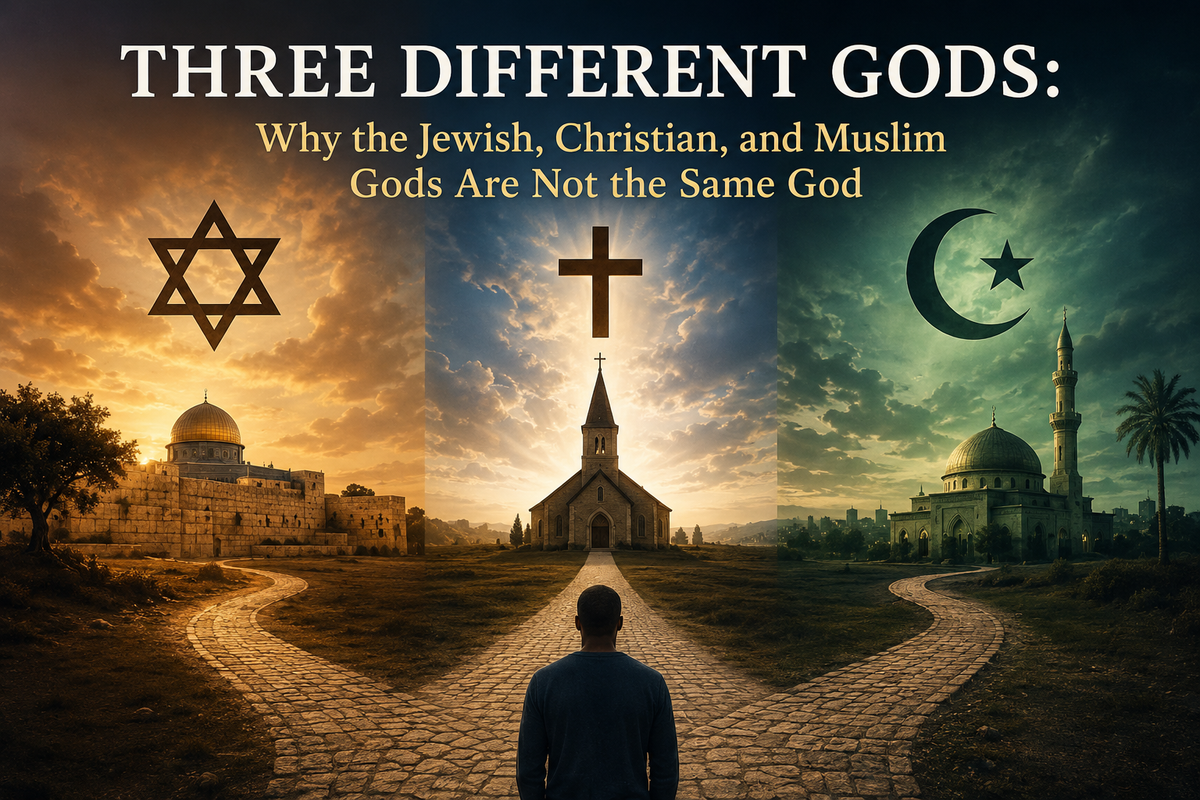
“We all worship the same God” is a familiar refrain at interfaith gatherings and in political speeches. The statement may be intended to promote goodwill and reduce religious tension. Yet when examined critically the claim fails. Christianity, Judaism and Islam each trace their origins to Abraham, but shared ancestry alone does not establish that they have the same God.
The central question is whether the three traditions describe the same being or three incompatible conceptions of God.
The most useful tool for examining this question is the Principle of the Identity of Indiscernibles, invented by Gottfried Wilhelm Leibniz. The principle states that if A and B are identical, then every property of A is also a property of B, and vice versa. If two purportedly identical beings possess mutually exclusive essential properties, they cannot be the same being.
Christianity defines God as tripartite: Father, Son, and Holy Spirit, three distinct persons sharing one essence. The incarnation of the Son in Jesus Christ is not a peripheral doctrine but one of Christianity's defining claims. Historically, Christians devoted centuries to refining this doctrine, sometimes excommunicating those who disagreed.
Judaism rejects this conception, basing its understanding of God in the Torah and the Deuteronomy 6:4: “Hear, O Israel: The Lord is our God, the Lord is one." Within Jewish theology, dividing God into multiple persons is incompatible with monotheism.
Islam likewise centers on the absolute oneness of God. The Quran explicitly rejects the Trinity and the sonship of Jesus (Quran 4:171). Thus Christianity affirms as essential precisely what Judaism and Islam deny as essential.
These descriptions cannot simultaneously identify one and the same being under Leibniz's criterion of identity. The incompatibility extends beyond attributes to historical actions. Christianity teaches that Jesus' crucifixion and resurrection are the decisive acts through which God accomplished humanity's redemption. The Quran (4:157) states that Jesus was neither killed nor crucified.
Significant differences also arise in covenant. Judaism emphasizes God's covenant with Israel. Christianity teaches that the Mosaic covenant reaches its fulfillment in Christ. Islam presents the Quran as God's final revelation and understands it as correcting or clarifying earlier revelations. These are not merely different emphases but competing accounts of God's approaches to humanity.
Defenders of the 'same God' claim often appeal to a causal theory of reference: because all three traditions trace themselves to Abraham, they argue that they continue to refer to the same God despite significant doctrinal differences.
Over millennia, Judaism, Christianity, and Islam developed distinct conceptions of God through separate theological traditions. Shared historical roots do not preserve oneness when each tradition defines God through incompatible essential attributes, contradictory actions, different covenants, and exclusive claims of revelation.
The "same God" claim may serve important social and diplomatic purposes by encouraging peaceful coexistence. Such language may promote cooperation across religious communities. Nevertheless, a statement may be valuable as a diplomatic gesture while remaining philosophically untrue.
If the issue is analyzed using identity conditions rather than aspirations toward interfaith harmony, the conclusion is straightforward. Judaism, Christianity, and Islam present conceptions of God that differ in essential nature, defining actions, covenant, and revelation. The three religions describe mutually incompatible conceptions of God rather than one identical being of worship.