The Rhetoric of Calling Something “Offensive”

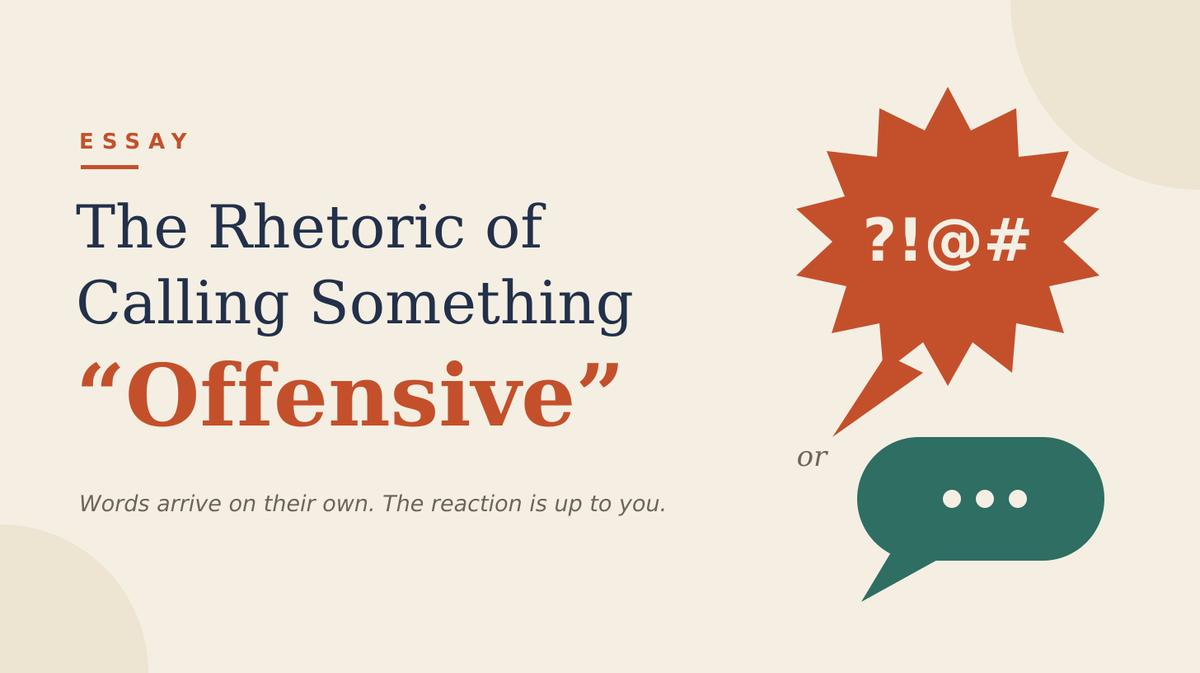
Please note that I am not saying it’s OK to call people names, negatively label people, or say mean things to them. What I am saying is that when you are on the receiving end, you have choices other than taking offense.
Choosing not to take offense to words helps you. Choosing to take offense (and taking and being offended is a choice) to words is problematic. First, what’s “offensive” is not objective. It’s subjective. Choosing to take offense may have the following potential negative consequences for you and others:
1. Stress: taking offense can lead to increased stress and negative emotions. It can create a cycle of frustration and anger, which can take a toll on mental well-being.
2. Impact on Relationships: choosing to take offense can strain relationships. Expressing that you were offended may lead others to feel like they are walking on eggshells around you, making it challenging to maintain positive and open communication.
3. Reduced Resilience: Developing resilience is crucial for navigating life’s challenges. Taking offense might indicate a lack of resilience, as minor setbacks or criticisms can have a disproportionate impact on one’s emotional state.
4. Closed-mindedness: Taking offense may lead to a closed-minded perspective, where you are unwilling to consider alternative viewpoints or engage in constructive discussions. This closed-mindedness can hinder personal growth and limit opportunities for learning.
5. Focus on Negativity: Taking offense can contribute to a negative mindset. Instead of focusing on the positive aspects of life, individuals who habitually take offense may become preoccupied with finding fault or offense in various situations.
6. Social Consequences: People may distance themselves from individuals who take offense, as it can be challenging to maintain healthy and enjoyable interactions when walking on tiptoes.
7. Ineffectiveness in Advocacy: If someone is offended by many things, it may dilute the impact of their concerns when addressing genuine instances of injustice or discrimination. Others might be less likely to take their concerns seriously if they perceive a pattern of overreaction.
8. Distrust: Frequently taking offense may lead others to question the authenticity of one’s reactions. Over time, people may become skeptical about sincerity, making it harder for them to empathize or support the individual in genuine moments of distress.
9. Increase in What You Consider “Offensive”: When person A points out to person B what is offensive to them, person B may say even more of what person A finds offensive. This is why choosing to take offense usually does not work. You get more of what’s offensive to you, not less.
Calling something “offensive” often shuts down the conversation. Recognizing that most words do not warrant a strong emotional reaction and developing emotional resilience can help mitigate the negative consequences associated with taking offense.
Alternatives to Taking Offense/Choosing to Take Offense
1. Dismiss the matter instead of reacting to it.
2. Understanding that taking offense to something gives it more power.
3. Taking offense to something usually wastes time.
References
Bonanno, G. A. (2004). Loss, trauma, and human resilience: Have we underestimated the human capacity to thrive after extremely aversive events? American Psychologist, 59(1), 20–28. https://doi.org/10.1037/0003-066X.59.1.20
Brehm, J. W. (1966). A theory of psychological reactance. Academic Press.
Chida, Y., & Steptoe, A. (2009). The association of anger and hostility with future coronary heart disease: A meta-analytic review of prospective evidence. Journal of the American College of Cardiology, 53(11), 936–946. https://doi.org/10.1016/j.jacc.2008.11.044
Ellis, A. (1962). Reason and emotion in psychotherapy. Lyle Stuart.
Epictetus. (1948). The Enchiridion (T. W. Higginson, Trans.). Bobbs-Merrill. (Original work published ca. 125 C.E.)
Gross, J. J., & John, O. P. (2003). Individual differences in two emotion regulation processes: Implications for affect, relationships, and well-being. Journal of Personality and Social Psychology, 85(2), 348–362. https://doi.org/10.1037/0022-3514.85.2.348
Kowalski, R. M. (1996). Complaints and complaining: Functions, antecedents, and consequences. Psychological Bulletin, 119(2), 179–196. https://doi.org/10.1037/0033-2909.119.2.179
Lazarus, R. S., & Folkman, S. (1984). Stress, appraisal, and coping. Springer.
Nolen-Hoeksema, S., Wisco, B. E., & Lyubomirsky, S. (2008). Rethinking rumination. Perspectives on Psychological Science, 3(5), 400–424. https://doi.org/10.1111/j.1745-6924.2008.00088.x
Poggi, I., & D’Errico, F. (2018). Feeling offended: A blow to our image and our social relationships. Frontiers in Psychology, 8, Article 2221. https://doi.org/10.3389/fpsyg.2017.02221
Porter, T., & Schumann, K. (2018). Intellectual humility and openness to the opposing view. Self and Identity, 17(2), 139–162. https://doi.org/10.1080/15298868.2017.1361861
Witvliet, C. V. O., Ludwig, T. E., & Vander Laan, K. L. (2001). Granting forgiveness or harboring grudges: Implications for emotion, physiology, and health. Psychological Science, 12(2), 117–123. https://doi.org/10.1111/1467-9280.00320