The Problems with the “Absentee Black Father” Trope

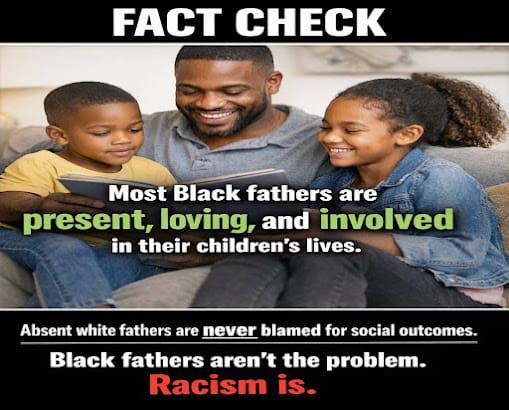
1. It’s factually misleading
Research shows that Black fathers are just as involved — or even more involved — than white fathers in their children’s lives, especially in non-residential situations. A 2013 CDC study found that Black fathers who lived with their children were more likely than white or Hispanic fathers to engage in daily activities such as feeding, bathing, and reading to their children, and that Black fathers living apart from their children were among the least likely to report no involvement at all (Jones & Mosher, 2013). This racist trope denies the reality of mass incarceration, economic inequality, and racial profiling that often forcibly remove Black fathers from their families.
2. It shifts blame from systems to individuals
By blaming “absentee Black fathers,” the focus is taken off structural racism — things like redlining, underfunded schools, discriminatory hiring, over-policing, and generational poverty, much of which was produced by deliberate government policy rather than private choice (Rothstein, 2017). It attempts to turn complex social and economic issues into a moral failing of Black men, which degrades them and erases the real barriers they face.
3. It has racist historical roots
This trope became prominent in mainstream discourse after the 1965 Moynihan Report, which framed Black poverty in terms of an alleged “breakdown” of the Black family and a “tangle of pathology” centered on family structure (Moynihan, 1965). Many white conservatives and some liberals later used this framing to justify racist policies under the guise of “family values,” rather than addressing racism and inequality directly.
4. It reinforces stereotypes
It fuels the image of the “irresponsible Black man” and the “broken Black family.” As Collins argues, such representations operate as “controlling images” — ideological constructs designed to make the subordination of Black people appear natural and to justify unequal treatment (Collins, 2000). In this case, the stereotype gets used to:
• Justify harsher criminal justice policies
• Block welfare support
• Shame and stigmatize Black families
These stereotypes feed into public policy and influence how institutions treat Black people — from schools to courts to media portrayals.
5. It denies resilience
This narrative is often used against Black communities rather than in service of them. It assumes Black families are inherently deficient and denies their resilience and complexity. Ethnographic research has documented the opposite: extended kin and friendship networks in poor Black communities form highly structured, resilient systems of mutual support that sustain childrearing under conditions of hardship (Stack, 1974). It also ignores the work that Black parents and extended families do to raise children amid discrimination and hardship.
Conclusion
The “absentee Black father” trope is a racist simplification that blames Black people for the effects of systemic racism — and distracts from the real causes of inequality.
References
Collins, P. H. (2000). Black feminist thought: Knowledge, consciousness, and the politics of empowerment(2nd ed.). Routledge.
Jones, J., & Mosher, W. D. (2013). Fathers’ involvement with their children: United States, 2006–2010(National Health Statistics Reports No. 71). National Center for Health Statistics. https://www.cdc.gov/nchs/data/nhsr/nhsr071.pdf
Moynihan, D. P. (1965). The Negro family: The case for national action. Office of Policy Planning and Research, U.S. Department of Labor.
Rothstein, R. (2017). The color of law: A forgotten history of how our government segregated America. Liveright.
Stack, C. B. (1974). All our kin: Strategies for survival in a Black community. Harper & Row.