So-Called Positive Stereotypes

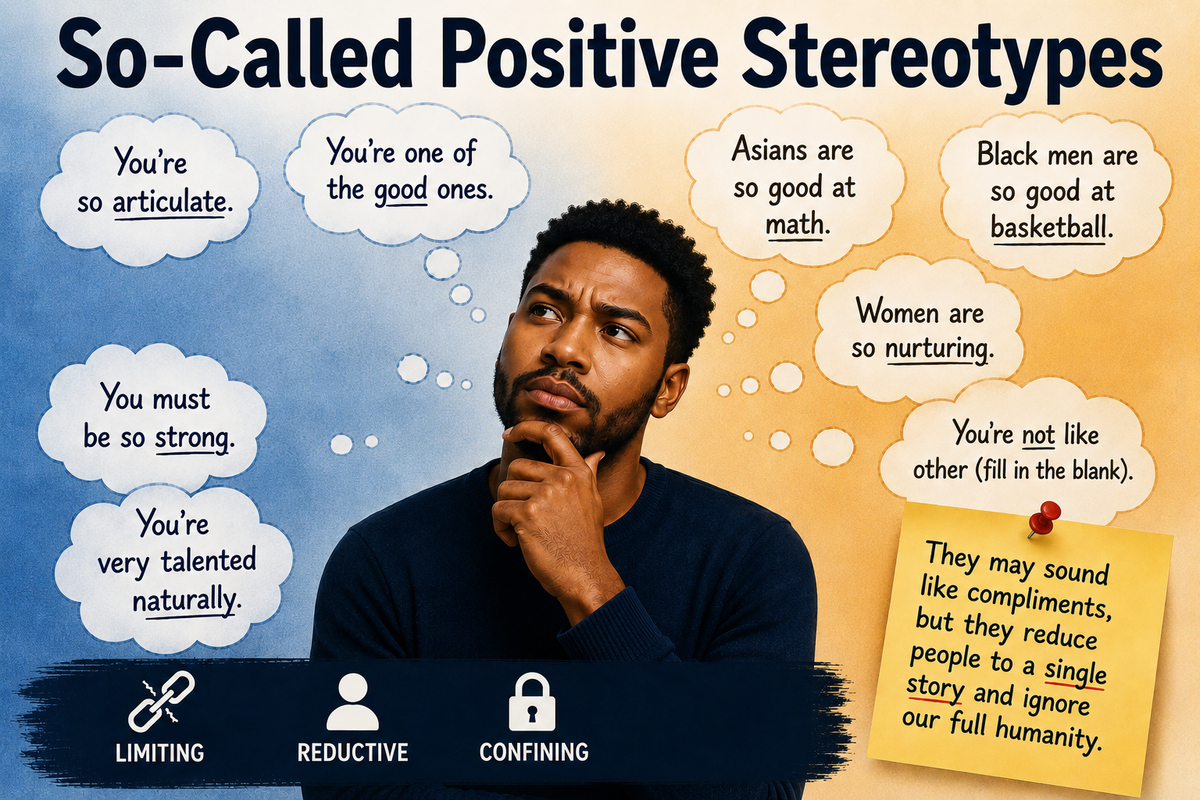
A positive stereotype is a subjectively favorable belief about a social group, one that assigns some advantage or superiority on the basis of category membership. Because such beliefs can sound like compliments, they may escape the social disapproval that may have reduced open expression of negative stereotypes. Endorsement of negative stereotypes has declined over recent decades while endorsement of positive ones has not. Positive stereotypes are still harmful, and several decades of experimental work in social psychology explains how.
Oversimplification and the Erasure of Individual Difference
Positive stereotypes generalize the characteristics or abilities of a group, producing a narrow and inaccurate picture of the individuals within it. The mechanism is the same one that operates in negative stereotyping: traits are assigned to a person on the basis of group membership more than direct observation. People whose qualities or difficulties do not match the group script are overlooked or not taken seriously, and the range of experience and talent inside the group disappears from view.
Expectation, Pressure, and Impaired Performance
Positive stereotypes create expectations that individuals may feel pressure to meet, which can produce inadequacy or a sense of failure. The experimental record here is more interesting than a flat claim of harm suggests. Social scientists have found that subtly making ethnic identity salient improved Asian American women’s math performance. Other social scientists repeated the study using a manipulation designed to make other people’s expectations salient, and performance dropped substantially, an effect carried by a reduced ability to concentrate. The same stereotype helped when quietly activated and hurt when it arrived as public expectation. This parallels the stereotype threat effects documented for negatively stereotyped groups, and it means the pressure claim should be stated as conditional rather than automatic.
A Signal of Underlying Prejudice
People who receive a positive stereotype tend to infer that the speaker holds negative stereotypes about them as well. Five studies found that women who heard a man state a favorable generalization about women were more likely to judge him prejudiced than women who heard no stereotype, an effect that held when extended to Asian American participants. Related finding: targets evaluate the person expressing a positive stereotype negatively. The inference is not oversensitivity. Someone willing to assign traits by category is signaling something about how they categorize.
Limited Opportunity
Assumptions about interests, capabilities, or suitable career paths follow from group membership, which narrows the range of options a person is encouraged to consider. This can be described as a socially acceptable means by which members of dominant groups direct members of disadvantaged groups toward the domains those groups have traditionally occupied. The supposed compliment arrives with a channel attached.
Attempting to Legitime Inequality
This is where positive stereotypes do work that negative ones cannot. Exposure to positive stereotypes increased endorsement of the existing social order, because a system that distributes different strengths to different groups looks balanced rather than unjust. The same structure is found in "benevolent" sexism, a subjectively favorable view of women as warm, pure, and deserving of protection that operates alongside hostile sexism to justify gender inequality. Stereotype content model shows why the trade tends to be built in: groups rated high on competence are frequently rated low on warmth, and the reverse, so a compliment on one dimension often carries a deficit on the other.
Compliments That Fail to Flatter
Praise directed at group membership rather than at individual achievement can be diminishing. Tracing to expectations about individual recognition: being credited for a trait one is presumed to hold by category denies the individual the standing to be assessed on their own record. Note that this is not the same as a backhanded compliment, which is praise with an insult embedded in it. A positive stereotype can be sincerely meant and still reduce the person to a category.
Conclusion
The harms are not uniform, and the performance research shows that outcomes depend on how a stereotype is activated and who is receiving it. The direction of the findings is consistent, however: positive stereotypes create inaccurate perceptions, constrain individual opportunity, communicate prejudice to their targets, and supply a more durable justification for existing inequality than open hostility does. Treating people as individuals rather than as instances of a category is the practical implication, and it applies to favorable generalizations as much as to unfavorable ones.
References
Cheryan, S., & Bodenhausen, G. V. (2000). When positive stereotypes threaten intellectual performance: The psychological hazards of "model minority" status. Psychological Science, 11(5), 399–402.
Czopp, A. M. (2008). When is a compliment not a compliment? Evaluating expressions of positive stereotypes. Journal of Experimental Social Psychology, 44(2), 413–420.
Czopp, A. M., Kay, A. C., & Cheryan, S. (2015). Positive stereotypes are pervasive and powerful. Perspectives on Psychological Science, 10(4), 451–463.
Fiske, S. T., Cuddy, A. J. C., Glick, P., & Xu, J. (2002). A model of (often mixed) stereotype content: Competence and warmth respectively follow from perceived status and competition. Journal of Personality and Social Psychology, 82(6), 878–902.
Glick, P., & Fiske, S. T. (2001). An ambivalent alliance: Hostile and benevolent sexism as complementary justifications for gender inequality. American Psychologist, 56(2), 109–118.
Kay, A. C., Day, M. V., Zanna, M. P., & Nussbaum, A. D. (2013). The insidious (and ironic) effects of positive stereotypes. Journal of Experimental Social Psychology, 49(2), 287–291.
Shih, M., Pittinsky, T. L., & Ambady, N. (1999). Stereotype susceptibility: Identity salience and shifts in quantitative performance. Psychological Science, 10(1), 80–83.
Siy, J. O., & Cheryan, S. (2013). When compliments fail to flatter: American individualism and responses to positive stereotypes. Journal of Personality and Social Psychology, 104(1), 87–102.
Siy, J. O., & Cheryan, S. (2016). Prejudice masquerading as praise: The negative echo of positive stereotypes. Personality and Social Psychology Bulletin, 42(7), 941–954.
Steele, C. M., & Aronson, J. (1995). Stereotype threat and the intellectual test performance of African Americans. Journal of Personality and Social Psychology, 69(5), 797–811.