Racist Pseudoscience: The Low-IQ Claim

What the claim actually is: "Low IQ" applied to Black people as a group is a racist trope rooted in a long history of pseudoscience used to justify slavery, segregation, and discrimination. It typically refers to aggregate differences in IQ test scores between racial groups that have appeared in some studies.
What the science actually shows: Measured average IQ scores do differ across socially defined racial and ethnic groups in many datasets, but the dominant scientific view today is that those group gaps are best explained by environmental, social, and measurement factors rather than by innate genetic differences between races. [1] Here is why:
IQ tests measure performance on specific tasks, not fixed biological intelligence. The validity of IQ testing as a metric for human intelligence is disputed, [2] and framing the question in terms of "race" is scientifically problematic because racial categories are social constructs that poorly map onto patterns of genetic variation relevant to cognition. [1]
Score gaps correlate strongly with socioeconomic factors, educational access, chronic stress, environmental exposures like lead, and generational wealth — all of which are products of historical racism, not race itself. Socioeconomic status explains considerable variance in IQ score differences between all racial and ethnic groups studied and at all ages. [3] On the environmental exposure side, research published in the Proceedings of the National Academy of Sciences found that lead exposure is associated with lower test scores among all children, and that non-Hispanic Black children are more likely to be exposed to lead and more likely to live in racially segregated neighborhoods, which amplifies the negative effects of that exposure. [4] Black children were more likely than white children to experience the worst of both. [5]
The gaps have narrowed significantly over time as conditions have changed, which would not happen if they were genetically fixed. James Flynn argued that the dramatic changes having taken place between one generation and the next point strongly to an environmental explanation, and that it is highly unlikely that genetic factors could have accounted for the increasing scores. [6] The Flynn Effect provides strong evidence for environmental influences on intelligence test scores — the rapid rate of change is far too fast for genetic evolution, demonstrating that IQ scores are highly sensitive to environmental factors. [7] The progressive narrowing of IQ gaps aligns with the idea that environmental factors play a crucial role in shaping intelligence, further challenging genetic determinism. [8]
There is no identified genetic mechanism linking race to intelligence, and race itself is primarily a social construct with limited biological coherence.Despite the tremendous amount of research done on the topic, no scientific evidence has emerged that the average IQ scores of different population groups can be attributed to genetic differences between those groups. In recent decades, as understanding of human genetics has advanced, claims of inherent differences in intelligence between races have been broadly rejected by scientists on both theoretical and empirical grounds. [2] A 2023 consensus report from the National Academies of Sciences, Engineering, and Medicine stated that race is "a socially constructed designation, a misleading and harmful surrogate for population genetic differences, and has a long history of being incorrectly identified as the major genetic reason for phenotypic differences between groups." [9] Quantitative genetic data refute the notion of racial substructure for human populations. [10]
Stereotype threat — the documented psychological effect of being aware of negative stereotypes — measurably depresses test performance. When African-American students' race was made salient in experimental conditions, they tended to earn lower scores on standardized testing than did other African-American students who did not associate their personal performance with their racial identity. [11] Stereotype threat has been found to account for racial and ethnic performance discrepancies on IQ testing among populations who would otherwise be expected to perform similarly. The pressure to not conform to the stereotype creates anxiety, which in turn adversely affects performance. [12]
The rhetorical function: People who deploy "low IQ" against Black people are almost never making a careful scientific argument. They are using the veneer of science to express contempt — which is precisely what makes it a racist remark rather than an empirical one.
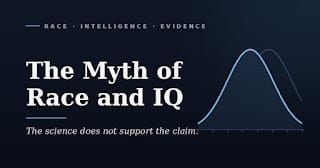
Conclusion: The science does not support the claim. The history of the claim is inseparable from the history of racism. And the people making it are rarely interested in the actual science.
Sources
[1] Factually.co — "Do different races have different IQ?" https://factually.co/fact-checks/science/do-different-races-have-different-iq-explained-6cda36
[2] Wikipedia — "Intelligence quotient" https://en.wikipedia.org/wiki/Intelligence_quotient
[3] Weiss et al., "Mediators of IQ test score differences across racial and ethnic groups: The case for environmental and social justice," Intelligence(ScienceDirect) https://www.sciencedirect.com/science/article/abs/pii/S0191886920301513
[4] University of Notre Dame News — "Early childhood lead exposure, exacerbated by structural racism, results in lower reading scores" https://news.nd.edu/news/early-childhood-lead-exposure-exacerbated-by-structural-racism-results-in-lower-reading-scores/
[5] NIH Research Matters — "Racial segregation makes consequences of lead exposure worse" https://www.nih.gov/news-events/nih-research-matters/racial-segregation-makes-consequences-lead-exposure-worse
[6] Wikipedia — "Flynn effect" https://en.wikipedia.org/wiki/Flynn_effect
[7] Cogn-IQ — "The Flynn Effect: Why IQ Scores Rose ~3 Points per Decade" https://www.cogn-iq.org/learn/theory/flynn-effect/
[8] Ithy — "Understanding IQ Disparities Among Racial Groups in 'The Bell Curve'" https://ithy.com/article/bell-curve-iq-racial-disparities-1n0mf02o
[9] Wikipedia — "Race and intelligence" https://en.wikipedia.org/wiki/Race_and_intelligence
[10] Feldman & Riskin, "Genes, culture, and scientific racism," PNAS (2024) https://www.pnas.org/doi/10.1073/pnas.2322874121
[11] EBSCO Research Starters — "Stereotype threat" https://www.ebsco.com/research-starters/social-sciences-and-humanities/stereotype-threat
[12] PMC — "Effects of Stereotype Threat, Perceived Discrimination, and Examiner Race on Neuropsychological Performance" https://pmc.ncbi.nlm.nih.gov/articles/PMC3642236/