I Bet You Have Never Heard of White American Vernacular English (WAVE)

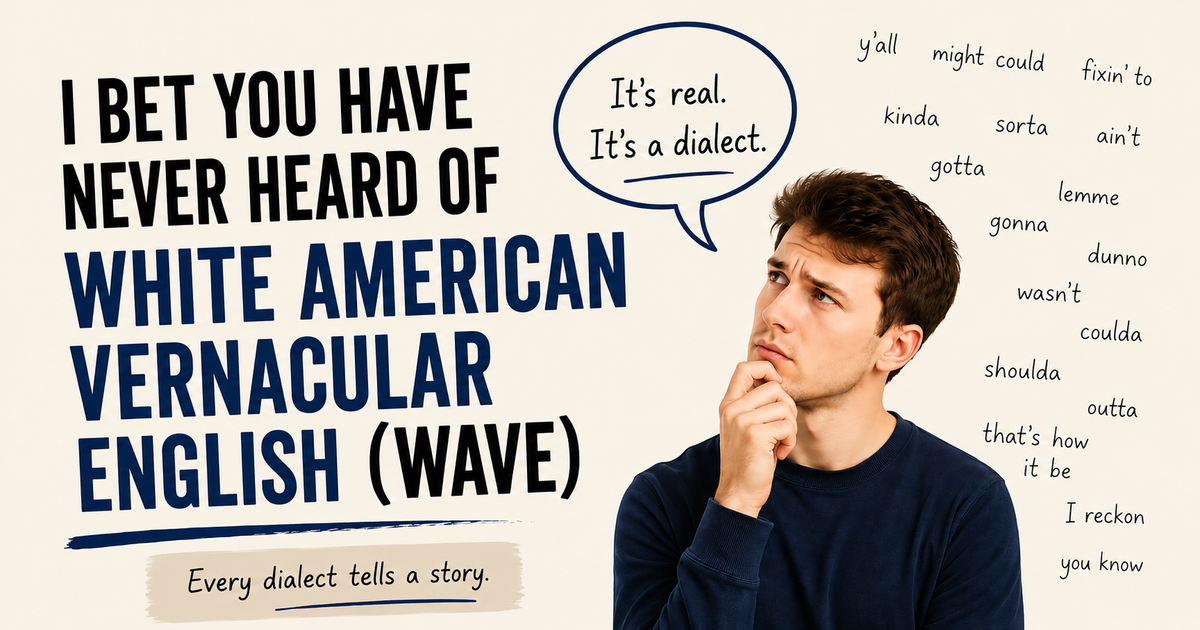
White American Vernacular English (WAVE) is a term sometimes used in academic or sociocultural discussions to refer to informal, everyday speech patterns commonly associated with white Americans, particularly from working- and middle-class backgrounds.
However, remember one can't “talk white” or “talk black” because you can't talk like a race of people (Alim & Smitherman, 2012).
What WAVE Refers To
WAVE includes features such as:
● Regional accents (e.g., Southern, Midwestern, Northeastern) (Wolfram & Schilling, 2016)
● Colloquial vocabulary (e.g., “y'all,” “dude,” “like,” “gonna,” “ain't”)
● Informal grammar structures (e.g., “I seen that movie,” or “She don't got none” in some dialects) (Wolfram & Schilling, 2016)
● Speech rhythms and cadences that differ from formal or standardized English
It's analogous in some ways to African American Vernacular English (AAVE), a systematic, rule-governed variety of English (Green, 2002; Labov, 1972), but it refers to informal English varieties spoken primarily by white Americans rather than Black Americans.
Why the Term Is Used
● Contrastive Framework: WAVE is sometimes used to draw attention to the fact that informal English used by white speakers is often treated as “normal” or “invisible,” while AAVE or other ethnic dialects are marked as “different” or “incorrect” (Bucholtz, 2001; Trechter & Bucholtz, 2001).
● Linguistic Equality: Some scholars use the framing to remind audiences that all people, regardless of race, use informal or vernacular English forms, and that these are valid and rule-governed dialects (Labov, 1972; Lippi-Green, 2012).
Examples
Here are simplified contrasts:
Standard English | AAVE | WAVE |
He isn't going. | He ain't going. | He ain't going. |
I don't know. | I dunno. | I dunno. |
I'm going to leave. | I'm finna leave. (Green, 2002) | I'm gonna leave. |
While “ain't,” “dunno,” and “gonna” can appear across multiple dialects, the cultural identity and context of the speaker may influence how the language is received (Lippi-Green, 2012).
Conclusion
WAVE is not as tightly defined or studied as AAVE, but it serves as a useful cultural counterpoint, especially when discussing language, race, and perceptions of correctness or professionalism in American English (Lippi-Green, 2012; Trechter & Bucholtz, 2001).
References
Alim, H. S., & Smitherman, G. (2012). Articulate while Black: Barack Obama, language, and race in the U.S. Oxford University Press.
Bucholtz, M. (2001). The whiteness of nerds: Super standard English and racial markedness. Journal of Linguistic Anthropology, 11(1), 84–100. https://doi.org/10.1525/jlin.2001.11.1.84
Green, L. J. (2002). African American English: A linguistic introduction. Cambridge University Press.
Labov, W. (1972). Language in the inner city: Studies in the Black English vernacular. University of Pennsylvania Press.
Lippi-Green, R. (2012). English with an accent: Language, ideology, and discrimination in the United States (2nd ed.). Routledge.
Trechter, S., & Bucholtz, M. (2001). Introduction: White noise: Bringing language into whiteness studies. Journal of Linguistic Anthropology, 11(1), 3–21. https://doi.org/10.1525/jlin.2001.11.1.3
Wolfram, W., & Schilling, N. (2016). American English: Dialects and variation (3rd ed.). Wiley-Blackwell.