Encouraging More White Men to Talk About Racism Productively

Introduction
Encouraging White men to talk about racism is partly about lowering defensiveness, raising curiosity, and reframing the conversation so it doesn’t feel like an accusation.
Many White men walk into conversations about racism expecting blame, guilt, being told they are personally racist, or being judged as “the problem.” This activates identity threat and shuts conversation down (Sherman & Cohen, 2002). When the self feels threatened, people respond to challenging information defensively rather than openly, and this pattern extends specifically to how many White Americans perceive and discuss racism (Adams et al., 2006). The entry point must avoid triggering threat while remaining honest.
Don’t call statements “offensive”
Even if a white guy says something that you feel is "offensive," calling something "offensive" usually shuts down conversation. Experimental work on confronting bias shows that hostile or high-threat confrontations produce more negative reactions toward the person doing the confronting, even when the confrontation still reduces biased responding; lower-threat framing better preserves the collaborative relationship and keeps the exchange open (Czopp et al., 2006). Instead, you can say, "I disagree with you, and how can we reframe this or understand this differently."
Start with curiosity, not correction
Questions such as “How did you learn about race growing up?” or “How do conversations about race usually go for you?” Communicate a desire to understand rather than to lecture. Reducing anxiety in cross-group exchange is one of the strongest mechanisms through which contact lowers prejudice (Pettigrew & Tropp, 2008).
Normalize that everyone has a racial story
Race shapes the lives of most people. Framing racism as a human topic positions White men as participants, not observers.
Focus on systems, not personal accusation
Shifting from individual morality to systems and structures reduces defensiveness and increases engagement. When identity threat is reduced, White men become more willing to recognize racism, and that increased recognition is stronger for scenarios describing institutional mechanisms than for individual ones (Adams et al., 2006).
What to avoid
Avoid lecturing, moralizing, labeling, name calling, attacking, shaming language, or assuming shared definitions.
Use Social Psychology
Many White men often opt out because they fear being attacked, exposed as ignorant, uniformed, or judged for saying the wrong thing. Psychological safety is essential (Edmondson, 1999). They are more willing when they feel listened to, not stereotyped, not morally judged, and not expected to feel guilty (Sherman & Cohen, 2002). Many White men directly observe racism but lack language, fear judgment, or believe the conversation isn’t meant for them. Emphasize shared inquiry and use real-world examples. (Pettigrew & Tropp, 2006).
Ask Open-Ended Questions
“I see the world one way partly because of my background. I imagine your experience might be different. What’s your read on it?”
How politics contributes to non-productive or counterproductive conversations
When racism is framed as partisan or ideological, political identity becomes the focus. This activates us versus them thinking, fixed pie thinking, rhetoric, culture-war scripts, defensiveness, labeling, name calling, and talking points rather than reflection. Research documents that many White Americans already construe racism as a zero-sum contest, perceiving gains for one group as losses for their own (Norton & Sommers, 2011). De-centering politics early allows deeper engagement.
White people can face racial prejudice, too.
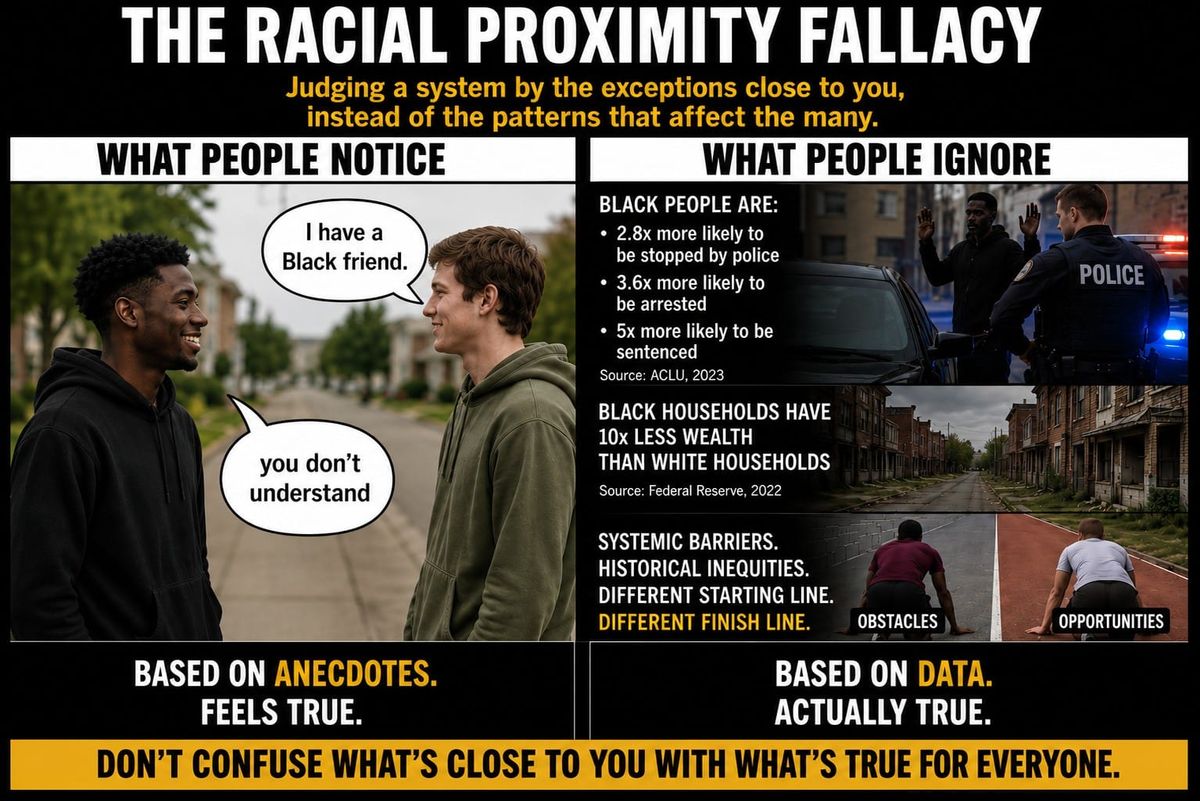
White people can face racial prejudice and discrimination too; however, it is not equivalent to what non-white people have and do experience. So, don’t make the mistake of false equivalence.
References
Adams, G., Tormala, T. T., & O’Brien, L. T. (2006). The effect of self-affirmation on perception of racism. Journal of Experimental Social Psychology, 42(5), 616–626. https://doi.org/10.1016/j.jesp.2005.11.001
Czopp, A. M., Monteith, M. J., & Mark, A. Y. (2006). Standing up for a change: Reducing bias through interpersonal confrontation. Journal of Personality and Social Psychology, 90(5), 784–803. https://doi.org/10.1037/0022-3514.90.5.784
Edmondson, A. (1999). Psychological safety and learning behavior in work teams. Administrative Science Quarterly, 44(2), 350–383. https://doi.org/10.2307/2666999
Norton, M. I., & Sommers, S. R. (2011). Whites see racism as a zero-sum game that they are now losing. Perspectives on Psychological Science, 6(3), 215–218. https://doi.org/10.1177/1745691611406922
Pettigrew, T. F., & Tropp, L. R. (2006). A meta-analytic test of intergroup contact theory. Journal of Personality and Social Psychology, 90(5), 751–783. https://doi.org/10.1037/0022-3514.90.5.751
Pettigrew, T. F., & Tropp, L. R. (2008). How does intergroup contact reduce prejudice? Meta-analytic tests of three mediators. European Journal of Social Psychology, 38(6), 922–934. https://doi.org/10.1002/ejsp.504
Sherman, D. K., & Cohen, G. L. (2002). Accepting threatening information: Self-affirmation and the reduction of defensive biases. Current Directions in Psychological Science, 11(4), 119–123. https://doi.org/10.1111/1467-8721.00182